
Tag: travel

  • DIY Roadside Motorcycle Repairs (5 Common Repairs)

    DIY Roadside Motorcycle Repairs (5 Common Repairs)

    Reading Time: 12 minutes

    I admit to leaving the house on my motorcycle for a weekend trip without any repair items except a multi-tool. My motorcycle is fairly new, I keep it well maintained and I have confidence it will perform well on my rides. But, I realize that when I’m out on the road, anything can happen. That unforeseen breakdown could happen at any moment. So, I decided to research some potential breakdowns and learn how to fix them. I know there are plenty more miss-haps that can happen and there are more serious breakdowns, but, these are just a few that, if one if prepared, can be fixed on the roadside and you can be on your way.

    1. Loose Chain

    If your motorcycle has a belt or shaft drive then this wouldn’t apply to you. If your drive system breaks down it’s likely a lot more serious. But chains stretch over time and they need regular lubrication. I was once reminded of this when I took a weekend camping trip to the Northern California coast. On my way home I notice a squeaky rattling noise. At my next stop I looked at my chain and it was bone dry and extremely loose. Unfortunately I didn’t have anything in my kit to lubricate it or adjust it. So, it home, about 100 miles and fixed it up there.

    So, what should you do if your chain is dangerously out of adjustment when you’re on a long trip? Below are the steps, tools and products you will need to clean, lube and adjust your chain on the roadside. These are general guidelines as the tools and steps may be specific to your motorcycle.

    • You will need the following:
      • A wrench that fits the rear axle bolt
      • A smaller wrench that fits the adjustment bolt
      • Small can of chain cleaner
      • Small can of chain lube
      • A Rag
      • Know your motorcycle’s recommended chain slack, found in the owner’s manual

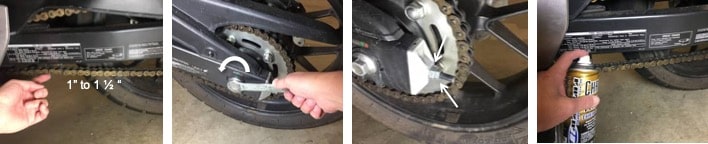
    It’s easier to do this adjustment if your bike is on a stand, but, if you don’t have a center stand, or a Snap Jack, it’s still possible to make this adjustment with the rear wheel on the ground.  Proper chain slack is generally between 1 to 1 1/2 inches but check your owner’s manual to be sure.

    • Steps
      • Clean the chain. While you won’t be able to do a thorough cleaning on the side of the road, you can at least get most of the dirt and grime off with a small canister of chain cleaner and a rag. Consider packing an old toothbrush too.
      • Loosen the rear axle bolt a couple of turns. It does not have to be very loose. Some bikes will have a cotter pin through the axel bolt. This should be removed and replaced with a new one if possible. If you don’t have a new one, don’t lose or break the one you have.
      • Most bikes will have an adjustment nut at the rear of the swing arm on each side and some will have two. If there are two, loosen the outer nut a few turns, then turn the inner nut clockwise a half turn at a time. This will pull the chain tighter. Always repeat the adjustment on the other side, equally.
      • Check the chain slack and repeat the turn by turn adjustment until the chain is properly tightened. Again, be sure to turn the adjustment bolts equally on both sides of the rear wheel.
      • Once the chain is at the correct tension, tighten down the rear axle bolt. Replace the cotter pin.
      • Final step, lube the chain. If your bike is not on a stand, then you will have to lube the chain in sections and roll the bike as you go.
    2. Broken Hose

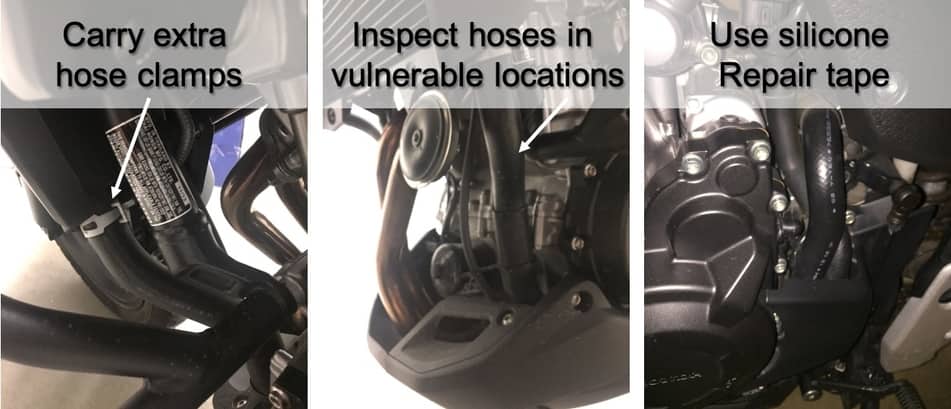
    A cracked or broken hose can affect a motorcycle in a lot of different ways depending on what hose is broken. Hoses will commonly break or form a crack at the connection point. If this is the case, you can often trim off the hose at the crack, fit it back on and clamp it down again. Carry extra hose camps with you in case one breaks.
    If you have a crack in a hose or in the fuel line, you can use silicone self fusing repair tape around the hole or crack. This type of tape sticks to itself when it is stretched and doesn’t rely on adhesives which can loose it’s ability to stick if it gets wet. When applying the tape, stretch it tight as you wrap to get a good seal. You can reinforce the repair by placing a few zip ties around the tape to prevent it from unwinding.

    A taped up hose is a temporary repair in most cases. Hopefully it will be enough to get you going again so you can ride to the nearest town for a permanent fix. So, remember to keep a few hose repair supplies in your tool kit especially if you are on a long trip in remote locations.
    3. Broken Clutch Cable

    A sudden broken clutch cable can leave you stranded on the side of the road. While it is possible to shift gears without a clutch in some circumstance, and you may be able to limp your way to the nearest town in second gear, replacing your clutch cable on the roadside is really the best option if this ever happens to you. It’s a relatively simple repair.

    A spare clutch cable specific to your motorcycle is one of my recommended repair items to take on long distance motorcycle trips. The repair usually only requires one tool: a 10mm or 12mm open end wrench which should always be included in your on board tool kit.

    The trickiest part of this repair is figuring out where the cable line threads through the motorcycle, and you may have to remove some side panels to see the path. So, when removing the old cable, pay close attention to where it goes.

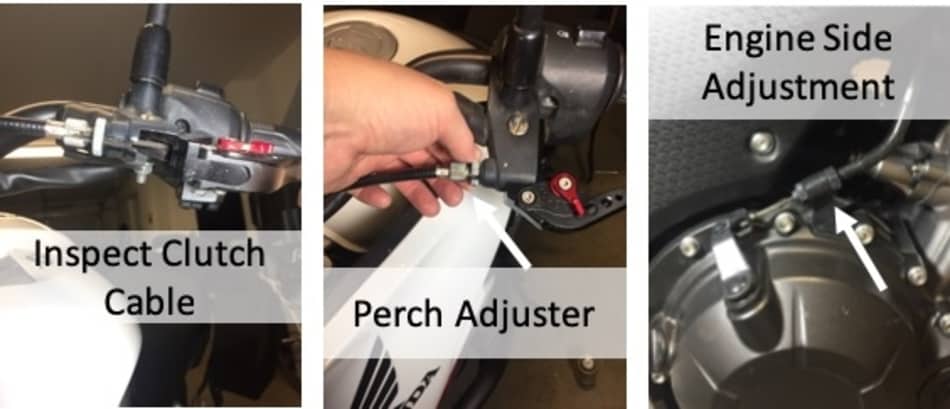
    • At the clutch lever, loosen the perch adjuster and move it all the way towards the cable to loosen the cable, and remove the cable from the clutch lever.
    • At the clutch end on the engine, loosen the adjustment nuts and remove the cable from the clutch bracket.
    • Take the new cable and squirt some lube down one end until a little bit drips out the other end. A small bottle of all purpose lubricant should be part of your on board tool kit.
    • String the new cable through the same path as the old cable. HACK: Don’t remove the old cable until you’re ready to install the new cable. String it through as you slide the old one out.
    • Attach the cable to the clutch lever first and secure it to the perch adjuster, leaving the cable loose.
    • Attache the other end of the cable to the engine side and tighten the adjustment nuts until the majority of the free play has been removed.
    • Do the fine adjustments at the clutch lever to remove any excess free play. Check your owner’s manual for the recommended amount of free play for your motorcycle. If you don’t get this adjustment spot on while on the road side, don’t worry, it’s ok to estimate.
    • After you set the free play, tighten the nuts at the engine side until they are secure. Then, tighten the adjustment screw on the perch adjuster.

    Before you put all your tools away, make sure the new cable is secured with all the necessary cable stays or zip ties. Turn your handlebars all the way to the left and right to check for any interference. Lastly, start the motorcycle and check the clutch engagement to make sure it’s in the right spot. Make any minor adjustment if necessary, and you’re ready to get back on the road.
    4. Broken Shifter Lever

    On many motorcycles the shifter lever is in a vulnerable location and can be broken if the motorcycle is tipped over, dropped, or crashed on its left side. Sometimes you can get yourself up and running with a generous amount of duct tape wrapped around the joint of the shifter arm and the toe lever. But, this repair is not going to last and can create a frustrating riding experience. So, your best bet is to do a quick roadside replacement of the shifter lever.

    This is probably one of the easier roadside repairs as it only needs a few tools and a replacement part. Make sure you carry a spare lever that fits your specific motorcycle. The tools needed will depend on your motorcycle but are often just a couple of hex key wrenches and small open ended wrenches, or you could use an adjustable wrench. In most cases you won’t have to remove any side panels or covers to access the lever and its attachment bolts.

    Some bikes also have a rocker arm that should be inspected to make sure it isn’t bent or cracked. Often, even if there is a slight bend to the rocker arm, your shifter will still function properly and this can be repaired later on. Also, on some bikes, the end of the shifter lever may be attached to the foot peg bracket and you may need to remove that bracket to replace the lever.

    5. Burned Out Headlight or Tail Light
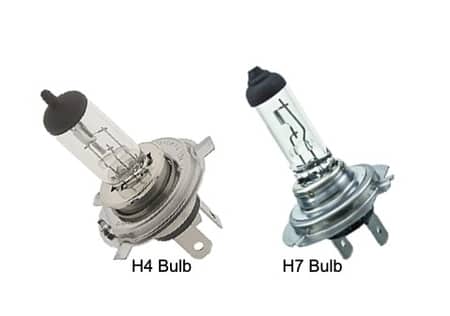
    The first step is to know what kind of bulbs your motorcycle requires and keep replacement bulbs in your on-board repair or tool kit. A lot of bikes, especially naked bikes or cruisers, use a standard H4 or H7 bulb that can be found at any auto parts store. Tail lights and turn signal light bulbs are much smaller and you should check your owners manual to find out exactly which bulbs to purchase for your kit.

    Pro Tip: Avoid touching the glass portion of the bulb. Oils on your hands can create hot spots which will cause the bulb to burn hotter, reducing the life of the bulb.

    It is much easier to replace a headlight bulb on a naked bike. Motorcycles with round, exposed headlights are by far the easiest but the exact procedure will depend on your make and model.

    • Start by removing the headlight lens using the required wrench for your bike.
    • Remove the connector from the back of the bulb. This will free up the headlight making it easier to work with.
    • Remove the rubber cover on the back of the lens. This protects the inside of your headlight from dust and moisture.
    • Remove the secure spring from the back of the bulb. You may have to loosen one of the small screws, but do not remove them completely.
    • Remove the bulb and inspect it to make sure it is blown. A burned out bulb will look a little brown and the filament inside will be broken. If it’s not, if the bulb looks good, then you may have a deeper problem, such as a bad fuse.
    • Replace the bulb with a new one. Line up the spacers on the bulb with the notches on the housing. It will only fit one way.
    • Plug in the connector.
    • Reverse each removal procedure and secure your headlight lens back on the motorcycle.

    Replacing the headlight bulb on a motorcycle with plastics is a bit more tedious, but you don’t always have to remove the covers to access the bulb. This, of course will depend on your make and model. Sometimes you will have access to the bulb by reaching down under the dash. But, on many bikes you will have to remove some covers, and possibly the entire dash, to access the bulb. You will follow the same procedures outlined above for removal and replacement of the bulb.

    Tips for Successful Roadside Repairs

    Keep track of your screws! If you’re on the side of the road you’re likely working on dirt, gravel or a grass surface. Dropping a screw or nut is a real pain in the neck and will be hard to find. So, get out some kind of container that you can keep all the screws, nuts, washers, clips and whatever bits and pieces you need to remove to make your repair. Use a removed cover as a tray, or get out a cup or bowl from your gear. And, whatever you do, don’t kick over the screw tray! Not that it’s ever happened to me.

    Be safe! Make sure you push your bike completely out of the roadway before you start making your repair especially if you are on a busy road. Having traffic zoom past you while you are kneeling down, preoccupied by your repair task, can make for a dangerous situation. Curious drivers often become fixated on what’s happening on the roadside which can cause them to swerve dangerously close. So, if you can pull into a parking lot, or stop at a pull out, rest stop or vista point, then you will be in a much safer place to do your motorcycle repairs.

    If you’re alone, especially for us women, accept the assistance of strangers only if you feel safe. Trust your intuition on this one. Most people who offer to help you out have nothing but good intentions, so you shouldn’t pass up the kindness of a stranger out of fear. In my experience, 99% of people are good and kind hearted. Your gut will tell you when to say thanks, but no thanks.

    It’s important to check if you need an oil change. Oil filters should also be replaced with every oil change. You can also do it by yourself. Install a new oil filter after the oil has been drained, then refill the engine with the right kind and quantity of motorcycle oil, as directed in the owner’s manual, using a funnel.

    Changing an air filter is essential. The performance of your motorcycle will suffer if the air filter, which keeps particles out of the engine, is dirty and clogged. Although it’s not always difficult, changing an air filter can take some time. While the gas tank and other components might need to be removed in order to access the air filter, this is not always the case. The air filter should be removed and replaced once you’ve entered the air box. Then put back everything you took out.

    Also, you may need to bleed your brakes out if they feel squishy. It’s quite easier to do on a bike than in a car. On a bike, the bleeder screw and brake levers should be easily accessible. Once you get to the brake levers and the bleeder screw, you can just bleed the brakes, which should make everything feel better.

    In any case, being prepared before you leave for your trip will help you get out of a tight spot, fix common problems on the road side, and get back on the road before you know it.
  • Tips To Rent a Motorcycle In The USA

    Tips To Rent a Motorcycle In The USA

    Reading Time: 15 minutes

    Have you ever planned a vacation to a beautiful destination and wish you could bring your motorcycle with you? Have you ever wanted to test ride a motorcycle for an entire day but dealers aren’t even willing to let you take it around the block? Are you planning on visiting the United States and want to see the country on two wheels? Renting a motorcycle could be your solution.

    In this post, I’ll talk about how to rent a motorcycle and everything that’s involved in doing so. I’ll try to answer all your questions like, what’s required to rent, how much does it cost, insurance, safety, where to rent, and anything else in between.

    Requirements for Renting

    Renting a motorcycle is similar to renting a car meaning that they don’t let just anyone jump in and drive off; you have to meet certain requirements. The most obvious requirement is a license and a credit card (any major credit card will do). Like car rental companies, motorcycle rentals require that you carry a valid driver’s license with an M1 rating, or motorcycle rating, that is recognized in the state you reside.  Unfortunately, a learner’s permit won’t cut it and will not be accepted by any rental company.

    If you are from a country outside the US, any motorcycle license that is recognized in your home country will be valid when renting. However, if your license is written in a language other than English, you should consider getting an IDP (international driver’s permit). This will eliminate any confusion or language barriers in the case of an accident or any encounter with law enforcement.

    Most motorcycle rental companies will have age limits and you must be at least 21 years old to rent. Of course if you were to rent a motorcycle in other countries this age would change. Some companies have raised this to 25 years old. Often, if you are younger than 21, you can rent a scooter, moped, or another small engine vehicle as long as you are over 18. The reason for this is to ensure that the renter has at least a few years of riding experience or maturity.

    Insurance Requirements

    The minimum insurance coverage for motorcycle rentals is liability insurance with a minimum amount of coverage and this may vary depending on the state in which you are renting. It is required by law. However, your own liability insurance that you have at home for your own motorcycle does not meet this requirement. Rental insurance is different and separate. Basic liability insurance is usually provided by the rental company and is included in the daily cost. This liability insurance will cover you if you cause an accident that results in injury or property damage to someone else.

    While liability insurance is the minimum amount of coverage required, there is always a way to increase your coverage if you want. Some companies will charge a daily rate for supplemental liability insurance. This will increase the amount of coverage in the case of an accident. For example, if the basic liability insurance covers up to $15,000, then the supplemental insurance will cover up to $30,000, or $50,000 depending on which plan you choose.

    Comprehensive insurance is also an add-on cost charged on a daily basis. This type of coverage will be in addition to the liability insurance and will cover you in the case of theft or damage to the motorcycle. For example, if the motorcycle turns up missing when you walk out of your hotel, this insurance will cover the cost of that theft. If the motorcycle is damaged by something other than your negligence; i.e. hit by a car, knocked over by someone, dented from a flying golf ball, smashed headlight from an angry, jealous bar patron after you hit on his girl, those damages will be covered by the comprehensive insurance.

    Often you can bump up your insurance coverage again to include loss or damage to your personal property. With this upgrade, you will be covered if someone breaks into your saddlebags or luggage and steals your personal belongings.

    Be aware that with any type of insurance coverage, there may be a deductible of anywhere from $500 to $5,000. So, even if the damage is covered, or even if the theft of the motorcycle is covered, you will be responsible for paying the deductible.

    It’s extremely important to read the fine print when dealing with insurance coverage. And, if you’re not on a super tight budget, it may very well be worth the cost to get the full coverage available so you can rent and ride without worrying about any of that. Paying a little extra per day would be better than buying the company a new motorcycle. Consider it based on the deductible amount, how long you’re renting, where you’re riding (although anything can happen anywhere).

    How Much Does it Cost?

    The cost of renting a motorcycle will vary depending on what type of motorcycle you rent. Smaller bikes tend to be cheaper while the big bore bikes and fully loaded cruisers will cost more. But, in general, you can expect to pay at least $125 per day for a small bike, and up to $300 or more for a big touring motorcycle. Select the bike that not only fits your budget but fits your riding ability. Some rental companies will offer discounts for military or law enforcement or if you are a member of an auto club such as AAA. And if you’re an old fart, over 55 or 60, they may have senior discounts. Check with the company to see if any apply to you.

    Security deposits are often required and are placed on a credit card when you rent the motorcycle. If all goes well, the security deposit will be refunded to you after the bike is returned. Depending on what kind of insurance coverage you choose, the security deposit can be as much as $5,000 and that amount MUST be available on the credit card used for the deposit. So, if they charge $3,000 for your deposit, but your card limit is only $2500, that card won’t be valid. So, be ready to have that credit available at the time of renting.

    Another common cost that people don’t always consider is the cancellation fee and late charges. Cancellation fees can be anywhere from 30% to 60% of the rental cost and some companies require cancellations 30 days in advance. So, cancel within a month of your trip or else you could be paying hundreds of dollars for not renting the motorcycle. This policy will be different for each rental company so before renting, make sure you understand it completely.

    Late fees are another cost that can surprise the renter. Most rentals are made on a 24-hour basis and if you rent a bike for 2 days, you will likely be required to return it at the end of the second day. In addition, you may have to return the bike during business hours so this may limit your return time. Always make sure you not only understand how many days your renting, but ask the company exactly what day and time the late fees will begin to incur. You’ll want to know this because late fees can be as expensive as $25 per hour. Yes, per hour.

    One last fee that some people don’t always expect is a surcharge. This is an extra daily charge if the motorcycle is rented during a special event such as a motorcycle rally or gathering. This is similar to what hotels do on holiday weekends, they increase the rates when they know their product is in high demand. So, if you’re renting to go to Sturgis, be ready for a surcharge.

    What’s Provided?

    When you get a motorcycle rental, the company is required to provide you with the motorcycle and one helmet. Of course, you can always use your own helmet if you prefer, but if you don’t have one, they are required to provide it. Also, even though some stated in the US do not have helmet laws, you may still be required to wear a helmet while operating the rental motorcycle, this is for insurance purposes. If you require a second helmet for a passenger, the rental company should have them available for a reasonable daily fee, like $10.

    Rental companies may also have riding gear, jackets, pants, leathers, and possibly gloves or boots that you can rent for a daily fee. The availability of these items will vary with each company. It’s also a good idea to ask if they recommend any local roads or routes that are fun on the motorcycle and they may provide route maps of nearby roads, so it’s a good idea to inquire about that. Motorcycle rentals are easily available for motorcycle riders. Rental motorcycles are easy to find with valid motorcycle endorsement. Motorcycle enthusiasts keep a track of great bike like a Harley Davidson and others that are available for rent. Eaglerider locations are the best spot for motorcycle riders to get rentals. The rental rates are usually non refundable and the rents are usually location or tours contract.

    The rental company should also provide you with an orientation of the motorcycle you’re renting. It’s important that you are familiar with the location of things like the gas tank (don’t laugh, sometimes it’s under the seat), turn signals, horn, ignition, kill switch, fuel switch if it has one, etc. It’s important that you feel confident and comfortable on the bike before you ride off, so, even if it’s not a required part of the inspection, take the motorcycle for a quick spin around the parking lot or block before you leave and ask questions if you have them.

    Limits and Restrictions

    Each rental company will have its own set of restrictions and limitations so it’s important to read the rental agreement to understand exactly what they are. Here are some restrictions you can expect.

    If you’re renting within the United States you will likely be required to stay within the US border. You will not be allowed to ride into Mexico or Canada unless you have made special arrangements with the rental company to do so.

    You will likely be restricted to riding on certain roads depending on what kind of motorcycle you rent. For instance, if you rent a street bike, you will not be allowed to ride that bike on unpaved roads, fire roads, gravel roads, on sand, or on any unauthorized road. Again, it’s up to the rental company to determine exactly what this means. Often, any supplemental insurance that you purchase will be void if you ride in a restricted area.

    Also, be aware of any mileage limits. Often you can purchase a rental plan that includes unlimited mileage, but make sure you are aware of any limitations before you sign the rental agreement. Some companies may go as far as to have you file a basic itinerary, but this may not be too common.

    What’s Expected of You, the Renter?

    You, as a renter, are expected to properly maintain the motorcycle while it is in your possession. While a good motorcycle rental company will make sure the bike is maintained and ready to go when you rent it, you are responsible for keeping it fueled up, keeping the chain lubed if you ride more than 1,000 miles, keeping the tires at optimal pressure, checking the oil level and other fluid levels daily before you ride. These are topics that should be covered in your orientation so there is no confusion regarding your responsibility and how to do these simple maintenance tasks.

    You are also expected to follow traffic laws for each state in which you ride. This includes speed limits, parking, curb colors, crosswalks, pedestrian right-of-way, left-hand turn lanes, and those pesky left-turn green lights where you have to wait for oncoming traffic. Whatever the rules are, you’re expected to know and follow them.

    On a side note, lane splitting is legal in only one state: California. Also on a side note, if you are visiting from outside the US, make sure you are familiar with how to pump gas in the states. It’s easy to get confused with different types of fuel such as diesel or ethanol.

    3-Wheeled Motorcycles

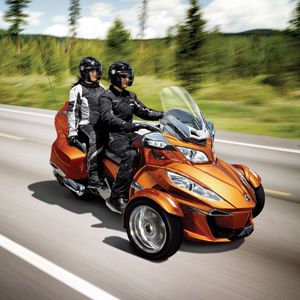
    If you are interested in renting a three-wheeled motorcycle such as a trike, Can-Am Spyder, or a Polaris SlingShot, you will run into different requirements as far as licensing goes. But, the good news is, that in some states, you may not need a motorcycle license at all.

    To ride a basic trike style motorcycle, such as the Harley Davidson Freewheeler or Tri-Glide you will need a motorcycle license, or a 3-Wheel vehicle license in most states, if not all of them. If you have a motorcycle license, you’re good to go. If you don’t, then you will need a 3-Wheel license. You won’t be able to rent one with a basic automobile driver’s license.

    Riding a Can-Am Spyder requires the same licensing as above unless you’re in California. In the state of California, it is legal to ride a Spyder-type vehicle with only a basic automobile driver’s license. It is the only state that allows this (as of 2018).

    The Polaris SlingShot has much more lenient requirements, probably because the vehicle closely resembles a car rather than a motorcycle and is controlled with a steering wheel instead of handlebars. Therefore, to drive the SlingShot, you only need a basic automobile driver’s license in most states. But, the states of Montana, Wisconsin, Maine, New York, and Massachusetts require that you have your motorcycle license to drive one.

    Not all motorcycle rental companies will rent 3-wheeled vehicles and you may have to seek out a dealership to inquire about rentals. In any case, you will likely be required to wear the same safety equipment as when riding a motorcycle, such as a helmet and proper riding gear.

    Peer-to-Peer Motorcycle Rental

    There is a new way to rent motorcycles that are gaining more popularity and that’s peer-to-peer motorcycle rentals. Think Air B-n-B for your bike. Companies such as twistedroad.com or riders-share.com provide platforms where people can list their own motorcycles for rent. You, as the renter, can search for an available bike in your area, communicate with the owner and make the rental arrangements.

    There are several benefits to this type of ride-sharing or motorcycle sharing. First of all, the rental prices are much lower than rental companies and they are set by the owner of the motorcycle. Second, you will likely have a much wider variety of motorcycles to choose from and you may even be able to rent a vintage bike or custom motorcycle.

    Payments and insurance are provided by the rental platform which takes that hassle out of the equation. Keep in mind that companies like riders-share.com will have stricter requirements than a basic rental company. For instance, renters must be at least 25 years old, have a minimum of 3 year’s riding experience, and renters must meet a list of criteria regarding traffic violations, DUI records and felony charges. So, if you consider renting from a peer-to-peer company, be sure to read their rental policies to make sure you meet those important criteria.

    Can I Rent a Motorcycle for a Track Day?

    If you’re interested in riding a motorcycle on the race track, (which by the way is one of the funniest things you could ever do as a rider) and you need to rent a ride, you will have to rent from a company that provides motorcycle specifically for the track. I can’t imagine any average motorcycle rental company that would allow you to ride one of their rentals on a race track due to the risk of crashing.

    Track Day Providers are companies that purchase the use of a race track for the day to allow amateur riders to learn how to ride the track and how to race their bikes. The organizers offer coaching, instruction, emergency medical services, mechanical services, and everything else to allow you, the average rider, the rip around the track on your motorcycle as fast as you can (for a price). Often these companies will provide motorcycles for rent. These bikes are specifically set up to be safe on the track. They are stripped down, safety wired, and have no lights or rearview mirrors.

    These rentals will often come with extras, not just bikes. The rental package may come with a set of race tires, tire warmers, pit services as well as coaching and instruction. So, if you want to do a track day, but don’t want to ride your own motorcycle, a rental through one of the companies might be the way to go.

    Related Questions

    How far in advance should I book a motorcycle rental? 

    This will depend greatly on the rental company that you choose, but keep in mind that it would be best to make a reservation several months in advance especially if you are riding in a popular location or for a rally or event. But, if you get a wild hair, there’s always a chance of last-minute availability, but that would be hit or miss.

    What if I get in an accident while renting a motorcycle?

    If you’re in an accident, follow the normal procedures in getting medical or emergency assistance if someone is injured. You will likely be required to notify the rental company as soon as you are able. Most rental companies will provide you with an emergency phone number to call for assistance in the case of an accident.

    What if my rented motorcycle breaks down? 

    Most motorcycle rental companies will provide a phone number for roadside assistance. Some rental companies will have special insurance for vacation interruptions. In these cases, depending on the coverage, the rental company may pay for your transportation or lodging. In the case of peer-to-peer rentals, you must notify the owner of the motorcycle immediately if the motorcycle breaks down or if you are involved in a traffic accident.

    Can I rent a 250cc motorcycle on a car Licence?

    Licensing requirements for motorcycle rentals follow the law of the land. So, if you have a car license, any motorcycle with a displacement greater than 150cc will likely require a motorcycle license.

    At what age can I get a motorcycle rental?

    For most motorcycle rentals you will need to be 21 years old. There are some rental companies that offer rentals for people under 21, but they will require you to show proof of having taken a motorcycle safety course or motorcycle riding training.

    How can I lease a motorcycle with no credit?

    To lease a motorcycle without credit can be difficult, but not impossible. First, you would need to go through a private owner or small dealership. Many of the larger dealerships require that you have an established credit history before you can sign a motorcycle purchase agreement.

    Do I need a motorcycle endorsement to rent a motorcycle?

    In general, a valid motorcycle license or a motorcycle endorsement on a car license is required. In some cases, you may be able to rent from one of the companies that provide rentals for those under 21 years old with proof of training or course completion.

    Do I need insurance for rental motorcycles?

    In most cases, you will need to provide proof of insurance or a guarantee of insurance from your personal insurer. In some states, the rental company may be able to get you an exemption from coverage if they have their own insurance policy on file for riders who have taken a safety course or training class.