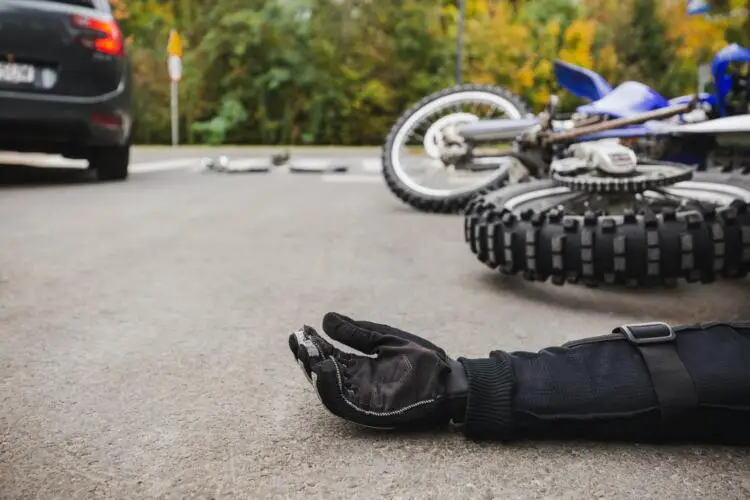
Author: Joel Hathaway

  • Jump Starting Motorcycle: Can You Jump Start Motorcycle With Car?

    Jump Starting Motorcycle: Can You Jump Start Motorcycle With Car?

    Reading Time: 6 minutes

    We all know that jump-starting a vehicle is one of the best ways to get your car or motorcycle moving with a dead battery. And there are many ways by which you can jump-start a motorcycle if its battery is dead. But can you do so with a car? Doesn’t a car battery and motorcycle battery have different voltages?

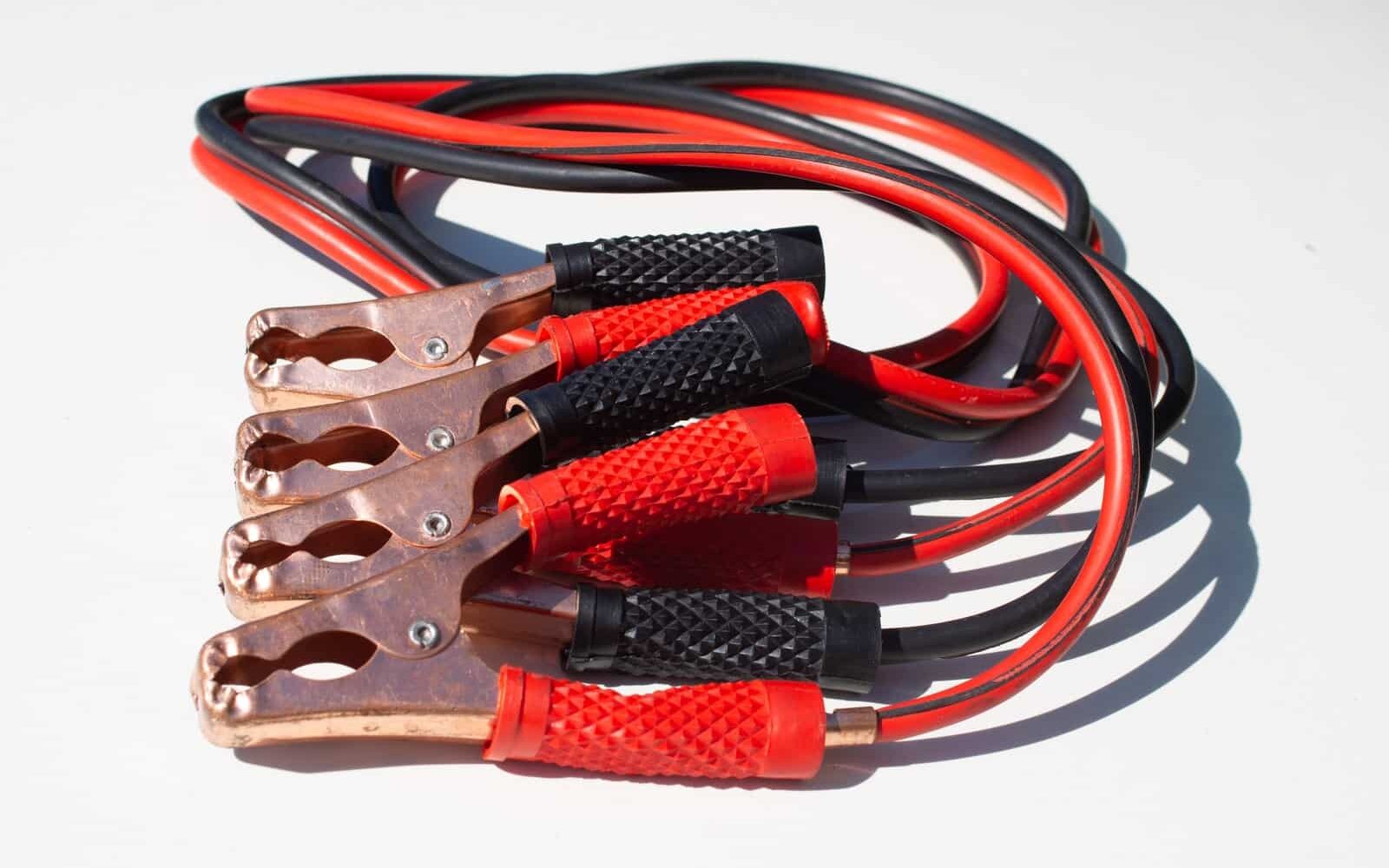
    To answer the specific question, ‘Can you start your motorcycle with a car?”, you will be happy to know that is absolutely possible to jump start your motorcycle with the help of a car. But this should be done with a high degree of care and attention because when the car is running, the high voltage of the car battery can actually damage the electronics of your beloved motorcycle if you’re not careful. All you need is a jump starter or jumper cable.

    Let’s look at how we can properly jump start a motorcycle with the help of a car without damaging motorcycle batteries.

    Step 1: Make Sure Both the Motorcycle and the Car are Turned Off

    red and black coated wire

    Car and motorcycle should be turned off before jump-starting.

    Both the motorcycle and the car, that is being used to jump start the other vehicle should be turned off. This is essential because if both vehicles are not completely shut down, this could cause serious damage to the electronics of your bike or car. And in some cases, it can even lead to an explosion.

    Turning one vehicle off while starting up another is a sure way of causing damage and potential injury to yourself or someone around you when trying to start up a dead battery on your motorcycle with a running car nearby.

    The high voltage from car batteries can actually fry all electronic components of your bike such as headlights, turn signals, electric fuel injection system, etc., which will result in a huge financial loss.

    So, when you are jump-starting your motorcycle with a car make sure the ignition of both the vehicles is turned off.

    Step 2: Connect a Single Red Clamp to the Positive Terminal of Your Motorcycle Battery

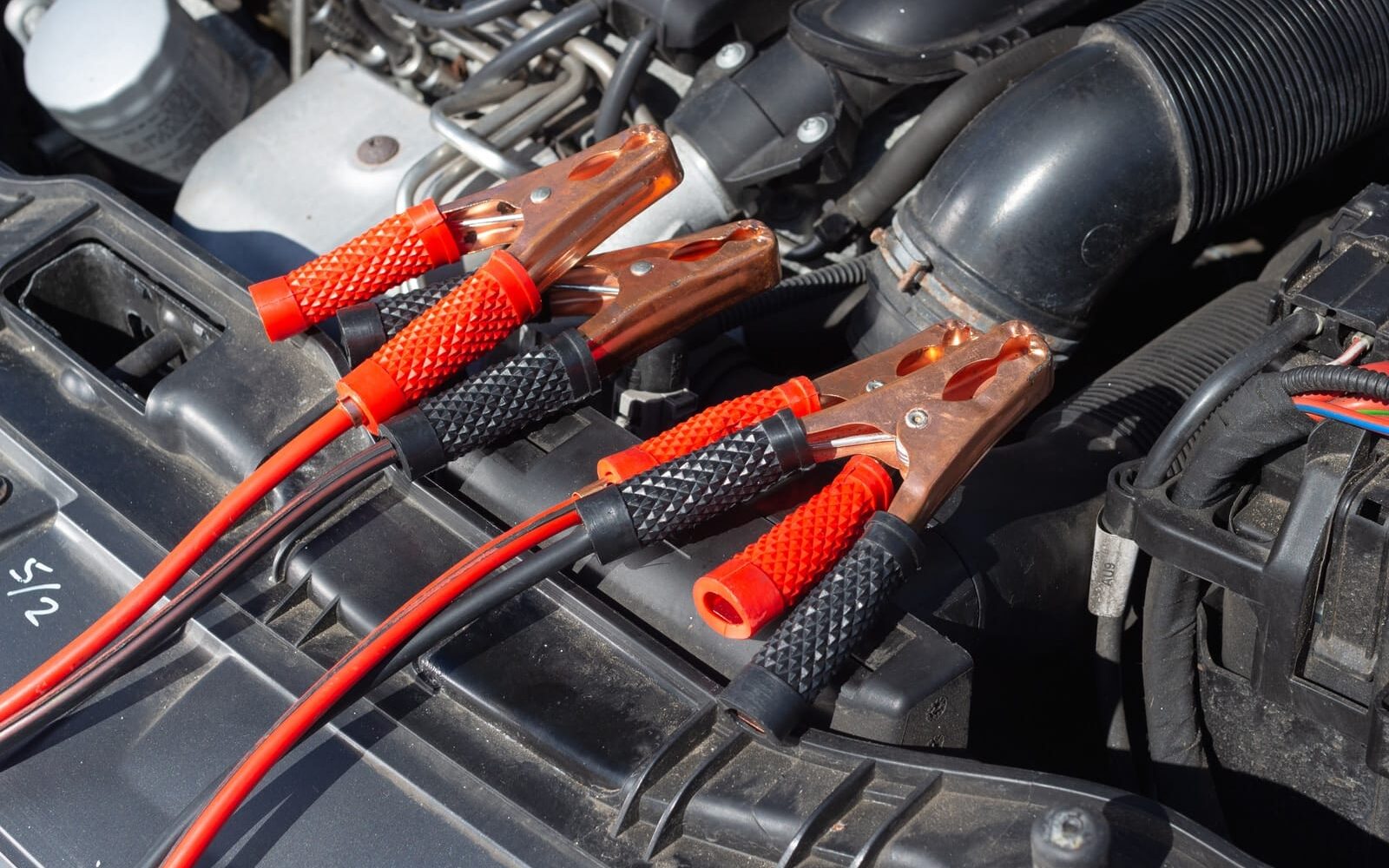
    black and brown handle hand tool

    Before we begin, let’s just debunk a myth, there is no such thing as motorcycle jumper cables, there are just jumper cables. It works the same both your motorcycle and car.

    Locate the battery terminals on the car and bike battery.

    Connect the red positive terminal of your motorcycle battery with the red positive clamp of jumper cables.

    Do not attach or let the other end touch any metal part on the motorcycle body including its engine, wheels, etc., to avoid causing damage. Also, make sure you are connecting your positive cable to your bike’s positive side and negative cable to your bike’s negative side. A wrong connection can create sparks that could have serious consequences.

    Next, connect one black clamp to the car battery post which is generally known as ‘ground’ in electrical terms. Pay special attention when attaching this ground cable because this will complete the circuit allowing electricity to flow from one vehicle to another through jumper cables.

    Step 3: Connect the Second Red Clamp to the Positive Terminal of the Car Battery

    Connect the second positive terminal of your motorcycle battery with the red positive clamp of jumper cables.

    Similar to Step 2, make sure that the clamp stays far away from any metal surfaces and does not come in contact with anything. You need to double-check that you are connecting positive with positive and not messing up the connection.

    After this, you need to connect the black clamp of the jumper cables to the negative side of the car battery but make sure that it does not come in contact with the positive side. Throughout the entire process, do not turn on your car and always leave it turned off.

    Step 4: Start the Motorcycle

    motorcycle starting

    Now it’s time to start your motorcycle. Until and unless the battery of your motorcycle is completely dead, it should get started right then.

    When you are jump-starting the battery of your bike, it would be a good idea to rev up the engine for 5 to 10 seconds at high speed before slowing down to normal idle speed. This will help in charging up your bike’s battery faster and enhance its performance.

    Once the engine starts, switch off all electrical accessories like lights, etc., on your bike to prevent draining of current from the vehicle’s battery. Also, take it easy while riding around after turning on the ignition because this can cause draining out of power due to additional recharging by running the engine.

    When you ride at a high speed, it can again create low voltage in your motorcycle battery which can result in shutting down the engine of your bike after you reach your desired destination.

    Step 5: Disconnect Cables in the Proper Sequence

    When you are using a jump starter or jumper cables to jump start your bike, it is very important that you disconnect them properly. First, remove the black cable connected to the negative terminal of the car battery and then remove the black cable connected to your bike’s negative terminal.

    Next, slowly disconnect the red positive clamp from your bike’s positive terminal. Lastly, take off both clamps attached near your bike’s engine so they do not touch each other or any metal parts on either vehicle.

    Conclusion

    Now you know if your motorcycle battery is completely dead and can’t start up at all, you can use a car’s battery to give it the boost it needs. This method to jump start a motorcycle works well but should only be used as a last resort since there is a chance of frying your bike’s electronics.

    However, when jump-starting a bike with a car, make sure that no part of the jump starter touches either vehicle during the activity.

    If any metal surface is accidentally touched by the clamps of jumper cables, sparks will fly causing damage to both vehicles. And lastly but most importantly make sure you are not connecting the red positive clamp with the negative terminal on either vehicle as it can cause a spark very easily.

    The method is somewhat safe, however, you must know what they are doing or have someone around that can help. If you are after a safer option then using a motorcycle push starting method might be a better option.

    Once you get the bike home using a portable jump starter is a better way of actually charging your bike.

  • Motorcycle Alternators (Simple Guide) Do Motorcycles Have Alternators?

    Motorcycle Alternators (Simple Guide) Do Motorcycles Have Alternators?

    Reading Time: 6 minutes

    Many people remain confused about the question, “Do Motorcycles have Alternators?” This is a common question that has one simple answer to it.

    Yes, almost all bikes these days have an alternator installed in them. The alternator is that critical device that keeps the battery of the motorcycle charged and makes sure it stays running, every time you take it for a ride on the road. Just like a car alternator, motorcycles need a device to generate power and supply electricity to their headlights, blinkers, and many other electrical system & circuits.

    Without an alternator, nothing of that sort would have been possible. You can think of your motorcycle alternator as a motorcycle charging system for your bike’s battery.

    In fact, your motorcycle won’t even start in the first place if it does not have an alternator. Modern bikes tend to consume a lot of power and therefore, the alternator becomes a very critical component of the bike.

    Functions of a Motorcycle Alternator

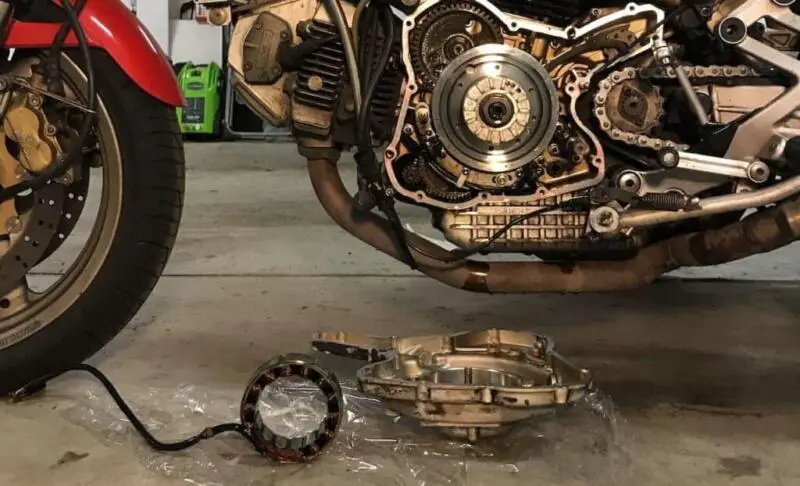
    The electricity is produced within the motorcycle stator of an alternator which has three coils arranged radially around it. A spinning magnet inside each coil generates a voltage across its surface and this voltage can be converted into direct current or alternating current depending on how many poles there are in the rotor winding at any given time – two-pole AC being most common.

    This is why motorcycles need an additional device called a regulator/rectifier (which converts DC to AC), which connects directly between the battery and starter motor with cables, instead of being directly connected to the stator. The main function of an alternator is to generate electricity, like a motorcycle charging system, and store it in a battery for later use, helping motorcycles run smoothly even on long journeys.

    In motorcycles with older electrical systems, the battery will be charged only when the motorcycle is running – which slows down starting time from a dead stop. With more modern motorcycles that have electronic ignition systems, this problem is long gone.

    However, motorcycles with no-load DC battery voltage regulators can recharge the batteries whenever they are moving down the road at speeds above four or five miles per hour (which means motorcycles will never discharge their batteries while stopped if their alternators are operating correctly).

    In addition to this major function of charging motorcycles’ batteries and powering any electrical device within it, motorcycles also use the alternator to monitor problems with electrical components on motorcycles, like the battery itself.

    If the voltage of the battery drops too low for any reason, the motorcycle’s electronic control unit (ECU) will switch on its warning light and/or signal the rider that something has gone wrong with the motorcycles’ power system.

    How does a Motorcycle Alternator Work?

    In layman’s terms, motorcycle alternators work by producing Alternate Current (AC) power. This is the power that ensures motorcycles’ batteries do not lose charge while the motorcycles are in use. The electricity is produced when a magnet rotates inside the stator coils of motorcycles’ alternators.

    Just because this process happens correctly, you can hop on your motorcycle anytime to hit the road. It happens when your bike is running and without this process taking place, all bikers will need to change their batteries with a new one, only after completing one or two journeys.

    The process goes like a cycle – the battery of a motorcycle produces Direct Current (DC), which is then used by the alternator to create a magnetic field which will in turn, convert the energy to AC. This converted energy is ultimately used to keep the motorcycle batteries powered. Without these motorcycle charging systems your battery would go flat within minutes of riding

    Many motorcycles require AC power for the process of ignition to take place while for fuel injection and lighting, they require DC power. When you ride your motorcycle, the motion and the kinetic energy that gets generated actually help the alternator to generate and distribute power to all the features of your motorbike’s electrical system. It’s important to say that DC generators are only used in older bikes.

    Difference Between Motorcycle Battery and Alternator

    motorcycle alternator

    In simple terms, battery powers motorcycles while alternator charges motorcycles

    As we’ve already mentioned, motorcycles require both a battery and an alternator to keep them running. The main difference between these two components is that motorcycles’ batteries can put out electricity (which motorcycles use to start up) but cannot take it in again. It means if you stop your motorcycle’s engine for some time, the motorcycles’ battery will lose its charge and motorcycles will not be able to start up again without either plugging the bikes into an electrical outlet or getting a new alternative power source installed on your bike.

    Motorcycles’ alternators take electricity from motorcycles’ batteries and turn it into AC power which then goes into powering various electrical components of motorcycles, as well as charging motorcycles’ batteries. This is why motorcycles need an alternator to start up and run properly.

    On the other hand, motorcycles’ batteries can’t take in electricity which means they can only put out DC power and cannot be used to turn AC power into DC power for motorcycles’ electrical systems which makes it crucial for motorcycles to have an alternator that can do this job instead.

    What Happens When a Motorcycle Alternator Doesn’t Work?

    One of the most common problems that can result from motorcycles’ alternators not working properly is the motorcycles’ inability to start up again. If motorcycles’ alternators are not producing AC power when in use, motorcycles will always lose DC power when they are up and running.

    Motorcycles with bad alternators can also experience intermittent or no power at all, which is an indication that motorcycles need a new alternator installed.

    When you have a bad alternator, your motorcycle battery will fail to hold the charge and it will feel sluggish to ride on it. Moreover, motorcycles with bad alternators also pose the threat of sparks being generated inside the motorcycles’ engine area which can become a fire hazard and motorcycles also run the risk of coming up with stalling problems while in use.

    Conclusion

    A motorcycle alternator is a very important system that motorcycles need to keep them going so motorcycles have batteries, too.

    Remember this simple equation: motorcycles have batteries and they also have alternators.

    Your motorcycles need both a battery and an alternator simultaneously to run smoothly and without suffering from sporadic or no power at all. Make sure you get a trustworthy professional to look into the issue of motorcycles’ not being able to start up again as soon as possible if you notice any unusual changes in your motorcycles’ behavior when they are running.

    If motorcycles’ alternators are not doing their jobs properly, then there is nothing much that can be done on your own other than getting them replaced or going for a repair from a professional service mechanic.

  • Understanding and Preventing Motorcycle Stator Issues

    Understanding and Preventing Motorcycle Stator Issues

    Reading Time: 9 minutes

    As a motorcycle enthusiast, it’s essential to be aware of the signs of a bad stator in your bike’s electrical system. The motorcycle stator is a critical component responsible for generating power to keep the battery charged and the engine running smoothly. When the stator malfunctions, it can lead to various problems, from dimming headlights to engine stalls. In this comprehensive guide, we’ll explore what a motorcycle stator is, its function, common symptoms of stator failure, and essential maintenance tips to keep your bike in top shape.

    What is a Motorcycle Stator and Its Function?

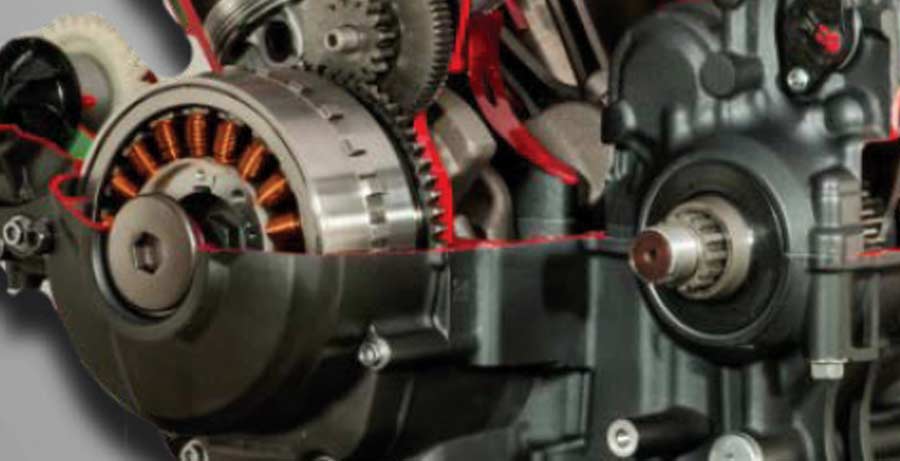
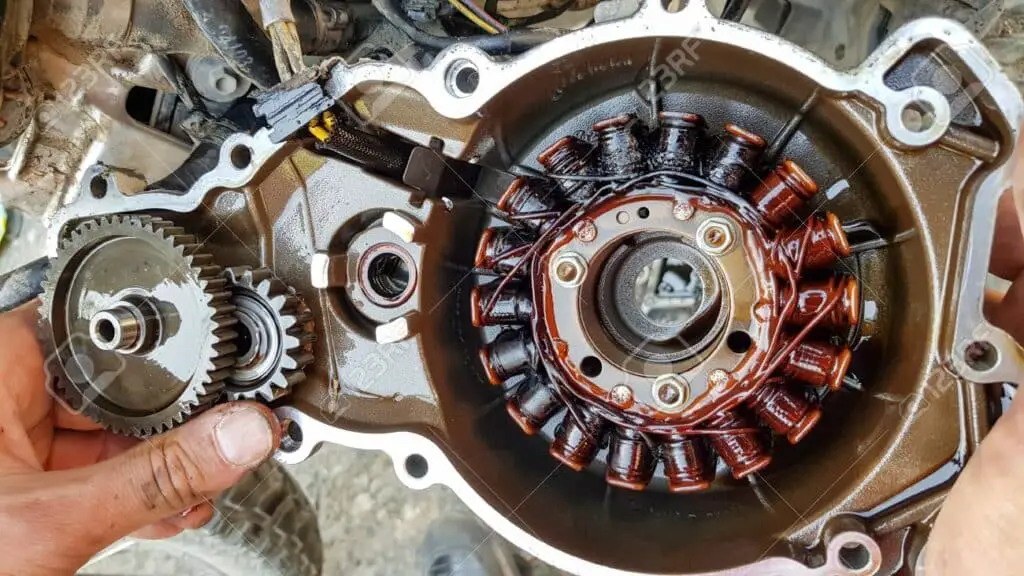
    Before delving into the signs of a bad motorcycle stator, let’s first understand its role in the motorcycle’s electrical system. The stator is a stationary component that collaborates with the rotor to generate the electrical power needed to operate the motorcycle. As the engine rotates, the stator produces an alternating current (AC), which is then converted into direct current (DC) by the rectifier/regulator. This DC power charges the battery and powers the bike.

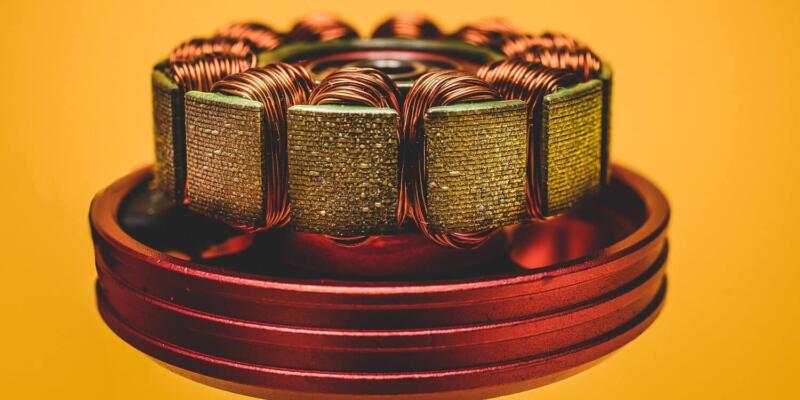
    The stator also plays a crucial role in the ignition system by generating power to create the spark that ignites the fuel in the engine. It’s a complex component composed of wire coils, metal plates, and magnets, requiring meticulous assembly and regular maintenance for optimal performance.

    In summary, the stator converts mechanical energy from the engine into electrical energy, which powers the motorcycle’s electrical system. It’s important to note that the stator’s performance depends on other electrical components, such as the battery and rectifier/regulator.

    Understanding Stator Failure: Common Symptoms

    A failing motorcycle stator can manifest several symptoms that affect the bike’s performance and rider safety. Recognizing these symptoms is crucial to addressing the issue promptly. Common signs of a failing stator include:

    1. Intermittent Power Loss: One of the most common signs of a bad stator is intermittent power loss, which can lead to the motorcycle suddenly shutting off while riding.
    2. Difficulty Starting: If your motorcycle struggles to start or requires frequent jump-starting, it may be due to a failing stator.
    3. Unusual Noises: A failing stator can produce unusual noises, such as a high-pitched whine, indicating a potential problem with the alternator.
    4. Overheating: A bad stator can overload the motorcycle’s electrical system, resulting in overheating of the wiring and other components.
    5. Electrical Problems: Various electrical issues may arise, including flickering lights, dim headlights, and other power-related problems.

    If you notice any of these symptoms, it’s crucial to take your motorcycle to a repair shop or a qualified technician for diagnosis and repairs. Ignoring stator issues can lead to further damage and pose a safety hazard.

    Dimming Lights and Electrical Power Issues

    Dimming headlights are among the most common signs of a bad motorcycle stator. This occurs when the stator fails to produce enough electrical power to maintain full brightness in the lights. In some cases, the lights may flicker or turn off entirely.

    Dimming headlights result from a drop in battery voltage, which happens when the stator can no longer produce sufficient power to recharge the battery. Consequently, the battery drains, and the lights lose their brightness.

    Addressing dimming headlights and other electrical power issues promptly is crucial. Failure to do so can lead to more severe problems within the motorcycle’s electrical system. To prevent further damage, have the stator inspected and repaired by a professional mechanic who can diagnose the issue and recommend the best course of action.

    Weak Spark and Ignition System Problems

    A failing stator can also lead to ignition system problems, such as difficulty starting or rough engine performance. The stator’s role in generating electrical power for the spark plug and engine ignition is critical. When the stator fails, it can result in a weak or inconsistent spark, causing engine misfires, stalling, and reduced performance.

    While ignition system issues can sometimes be attributed to other factors like faulty spark plugs or damaged wires, a failing stator should not be ruled out. If you suspect your motorcycle’s stator is affecting the ignition system, consult a professional mechanic. They can use specialized tools to diagnose the issue and determine if a replacement stator is necessary for proper functioning.

    Engine Stalls and Low-Speed Coil Issues

    Engine stalling, especially at low speeds, is a common symptom of a failing stator, often linked to problems with the low-speed coil within the stator. This coil is responsible for providing power to the motorcycle’s ignition system at lower speeds. When the stator fails, it can lead to weak or inconsistent power output, resulting in engine stalls. This can be particularly dangerous when riding in traffic or challenging terrain.

    If you’re experiencing engine stalling, it’s essential to have your stator examined by a qualified mechanic. They can diagnose the specific issue and determine whether the low-speed coil is the root cause. Addressing this problem promptly is vital to prevent further damage to your motorcycle’s electrical system.

    Additionally, keep in mind that symptoms like dimming lights and a weak spark can also contribute to engine stalling if left unattended. Therefore, it’s crucial to recognize all the symptoms of a failing stator to ensure proper maintenance of your motorcycle.

    The Importance of Visual Inspection and Maintenance

    Regular visual inspection and maintenance of your motorcycle’s stator and other electrical components are essential for optimal performance. These practices not only help identify potential issues early but also prevent more significant and costly problems down the road.

    During a visual inspection, pay attention to signs of wear and tear, such as frayed wires, loose connections, and corrosion. Inspecting the stator’s electrical connectors for signs of overheating is also crucial, as overheating can damage the stator’s windings. If any issues are detected, seek professional assistance from a repair shop to mitigate potential safety hazards.

    Routine maintenance of the stator involves periodic cleaning and testing. This can be performed by a professional mechanic or, if you’re knowledgeable about electrical components, by yourself using a multimeter. Testing the stator’s output voltage will help determine if it’s producing the correct amount of power.

    When conducting maintenance, ensure you use the appropriate tools and equipment. Applying insulating paint to the stator’s electrical connectors can prevent corrosion, while avoiding situations of power overload can extend the stator’s lifespan. If your motorcycle’s stator is old or worn, consider replacing it with a new, reliable stator to prevent potential issues.

    If you’re uncertain about how to perform visual inspection and maintenance on your motorcycle’s stator, seek professional guidance from a qualified mechanic or repair shop. They can offer expert advice on caring for your motorcycle’s stator and other electrical components to ensure optimal performance.

    Signs of a Failing Stator: What to Watch Out For

    While the symptoms discussed earlier are the most common indicators of a failing stator, there are additional signs to be vigilant about. If you notice your motorcycle’s engine struggling to turn over or the battery draining more quickly than usual, these could be early signs of stator failure. Similarly, if you detect unusual noises or odors emanating from your motorcycle, it may be attributed to a failing stator.

    It’s crucial to understand that a failing stator is not a problem that resolves itself; it only worsens over time. The solution is straightforward: replace the failed stator with a high-quality one from a reputable manufacturer. A new stator not only restores your motorcycle’s proper functioning but also ensures the issue doesn’t recur anytime soon.

    Remember that delaying the resolution of stator failure can lead to a complete electrical system breakdown, leaving you stranded on the side of the road. Act proactively and seek professional assistance as soon as you notice any symptoms of stator failure. With proper maintenance and care, you can avoid costly repairs and keep your motorcycle running smoothly for years to come.

    Troubleshooting the Motorcycle’s Stator

    If you suspect that your motorcycle’s stator is causing electrical issues, you can take a few troubleshooting steps before seeking professional help. Here’s a brief guide:

    1. Check the Instrument Cluster: Examine your motorcycle’s instrument cluster for warning lights or abnormal readings. Low or fluctuating battery voltage displayed on the cluster could indicate a failing stator.
    2. Inspect Stator Wires and Connectors: Examine the stator’s wires and connectors for signs of damage or wear. Corrosion of the stator’s electrical components can lead to power generation issues.
    3. Conduct Voltage Testing: If visual inspections reveal no issues, consider conducting a voltage test to determine the stator’s functionality. A digital multimeter can be used to test the stator’s voltage output at different RPMs.

    It’s important to remember that other electrical components, such as the regulator/rectifier or battery, can mimic stator failure symptoms. Therefore, conduct a comprehensive diagnosis before assuming the stator is the culprit. Once you’ve identified the issue, address it promptly. Ignoring a failing stator can result in further damage to the motorcycle’s electrical system and potential roadside breakdowns. If you’re unsure about troubleshooting or repairing the stator, seek assistance from a professional mechanic or repair shop.

    Preventing Stator Problems: Maintenance Tips

    Preventive maintenance is crucial to avoid stator problems and keep your motorcycle running smoothly. Here are some maintenance tips to help prevent stator issues:

    1. Inspect Stator Wiring and Connectors: Regularly check the stator’s wiring and connectors for signs of wear, damage, or corrosion.
    2. Consider Stator Replacement: If your stator is old or showing signs of wear, consider replacing it with a new, reliable stator to prevent potential issues.
    3. Apply Insulating Paint: Use insulating paint on the stator’s electrical connectors to protect them from heat and external factors.
    4. Avoid Power Overload: Ensure you don’t exceed your motorcycle’s maximum electrical load and use the correct voltage and wattage bulbs to avoid power overload situations.
    5. Clean Electrical Components: Routinely clean the motorcycle’s electrical components, including the stator, to remove debris and dirt that could cause damage.

    By following these maintenance tips, you can keep your motorcycle’s stator in excellent condition and prevent stator-related problems. Additionally, conducting visual inspections at regular intervals can help detect early signs of damage. If you observe anything unusual during inspections, seek professional assistance from a qualified mechanic or repair shop. Remember, taking care of your motorcycle’s stator is essential for preventing issues down the road and ensuring your bike’s longevity.

    Seeking Professional Help for Stator Issues

    If you’ve identified any symptoms of a failing stator in your motorcycle, it’s crucial to seek professional assistance from a qualified mechanic or repair shop. Attempting to diagnose and repair stator issues on your own can be risky and may lead to further damage to your motorcycle’s electrical system.

    A professional mechanic possesses the necessary experience and tools to accurately pinpoint the problem and provide the appropriate solution. When searching for a repair shop, look for one that specializes in motorcycle electrical systems to ensure your bike receives expert care.

    Furthermore, ask for references and read online reviews to verify the repair shop’s reputation and track record in successfully addressing stator issues. Remember that a faulty stator can cause serious problems if left unattended. Don’t hesitate to seek professional help to ensure the safety and proper functioning of your motorcycle.

    Conclusion

    In conclusion, understanding the signs of a bad motorcycle stator is vital for maintaining your bike’s electrical system’s health. Neglecting these symptoms can lead to severe problems and potential safety hazards.

    As discussed, a failing stator can cause issues such as dimming lights, weak sparks, engine stalling, and more. Regular visual inspections and maintenance play a crucial role in identifying and preventing stator problems.

    If you do experience stator issues, don’t hesitate to seek professional help from a skilled mechanic or repair shop. They can diagnose and address the problem, ensuring your motorcycle operates safely and efficiently.

    Remember that prevention is key to avoiding stator problems. Taking care of an old stator, applying insulating paint, and avoiding power overload situations are some ways to maintain your bike’s electrical system’s health.

    By following these tips and recognizing the signs of a bad stator, you can keep your motorcycle running smoothly for years to come.
  • How often to service a motorcycle?

    How often to service a motorcycle?

    Reading Time: 5 minutes

    Motorcycle care, maintenance, and servicing are very important for your bike to keep you safe and prolong the longevity of your vehicle. Therefore, service intervals are critical if you want to keep your bike in good working condition.

    Service your bike every 3000 miles or every six months (whichever comes first). If you have just purchased a new bike, you should take it for servicing just after 500 miles or 800 km.

    Although the service interval depends on weather conditions, local terrain, riding style, and the rider preference, until and unless you do it regularly, not only will you be compromising the condition of your motorcycle but you will also put your safety on the line. But here are some common questions you need to ask your service mechanic during the servicing sessions to be absolutely sure that the care you are giving to your bike is proper and substantial.

    What type of maintenance is recommended for my bike?

    Typically, motorcycle service intervals range from 3 months or 3000 miles up to 12 months or 12000 miles. A few exceptions are there depending on the type of bike you have and the manufacturer’s recommendations.

    However, if you are going to ride your bike under severe conditions such as racing, then the number of service intervals will increase a little bit.

    How often should I change my oil?

    Oil changes should be performed based on your daily commute or how frequently you ride. If you commute 5-7 days per week for over 1 hour at a time, you need to change your oil every month (3000 miles). If you ride less than that, once every 2-3 months (6000 to 9000 miles) is recommended.

    Is the Repair Worth the Cost or Should I go for Replacement?

    While choosing between motorcycle repair vs replacement, there are a few things you must keep in mind. First and foremost, the overall condition of the bike must be taken into account.

    If your bike is still under warranty, it might not be worth paying for repairs that incur only small costs without fixing the issue properly. When considering repairs over complete bike replacement, you have to remember that just spending more money on tune-ups and proper servicing can actually save you thousands over time. Also if your current bike has loads of features that are not available on any other model, then it’s better to go for partial repairs instead of an entire replacement because who knows what might come up next!

    Remember, even though motorcycles are much smaller than cars they do demand almost as much attention. As a result, you must follow the service intervals to avoid safety hazards and excessive wear and tear of your bike’s components.

    What is Included in the Estimate?

    You must ask your mechanic the specific components that will be replaced or repaired and what is included in the estimate. You might need to pay extra for certain parts and labor depending on the condition and mileage of your motorcycle, but it’s better to know everything beforehand before doing anything.

    Be sure to get a complete list of all the services you will require and compare this list with previous estimates from other service shops as well as lookup the online reviews. By gathering information on both options, you can ensure that you are getting an accurate quote that reflects the actual work required for your bike repair or service.

    What can I Keep in Mind to Avoid the Problem in the Future?

    At the end of your service, your service manager should provide you with a list of things you can do to prevent another breakdown. Be sure to ask about these strategies and remember them in the future.

    For example, with oil changes, service managers will often provide you with a new maintenance schedule that includes fuel filters and air filters as well. Be sure to ask the pros and cons of these recommendations as well as how often you should replace them to prevent future problems. Remember, when it comes to regular maintenance, there is no shortcut for safety on the road.

    When you follow the recommendations and the guidelines given to you by your service mechanic, it’s possible to increase your bike’s lifespan.

    Do the Repairs or the Service come with a Warranty?

    The majority of motorcycle repairs and services come with a standard warranty. Generally, the length of time will be determined by the type of work done and whether you purchased an extended care plan from the dealership.

    If there is any deviation, make sure to ask about warranties and what they cover beforehand to ensure that you are completely satisfied with your investment!

    It is not a luxury to have a service warranty for your motorcycle – it’s more of a requirement than anything else. A service warranty will help you save money in the long run by ensuring that any repairs done on your bike are covered if something goes wrong.

    Service warranties come with certain terms and conditions which vary depending upon the type of work done and whether or not you purchased an extended care plan from the dealership where you bought your bike – so be sure to ask about these things beforehand!

    Conclusion

    Having a high-performance bike can be quite exciting, but maintaining it requires a lot of time and effort. By following proper motorcycle maintenance guidelines, you can ensure that your bike is running at optimum performance.

    Your bike breaking down every once in a while is inevitable, but by caring for it properly and investing in repairs or services as needed, you can increase its lifespan and save a ton of money over time.

    With these tips in mind, there is no reason why you cannot find reputable shops to service your beloved bike at a reasonable cost. So, take good care of your bike on a regular basis because when the health of your bike is maintained properly, your safety on road is taken care of adequately.

  • What is the freezing point of gas in a motorcycle tank?

    What is the freezing point of gas in a motorcycle tank?

    Reading Time: 5 minutes

    The freezing point of Gas in a motorcycle tank comes to mind during the dark, cold, and frigid wintery months. If you worry about waking up in the morning and finding your motorcycle tank filled with ice cubes, you should know that, unlike water, gas does not have a specific freezing point.

    It’s proven that any form of gas freezes anywhere between -45° F to -200° F. However, according to a study conducted by the Illinois Department of Physics, gasoline freezes somewhere between -40° and -50° Celsius or -40° to -58° Fahrenheit. There are other papers that show most gasoline freezes at approximately -73°C (-100F).

    One thing is that our natural environment will never experience such low temperatures, at least with us humans on the planet but, there are things that you should know as to what to do to prevent the gasoline in your motorcycle tank from freezing.

    Keep the Battery Charged Up

    If you run your motorcycle’s engine and the battery is dead, it will not be able to pump any fuel. So, before even thinking about doing anything else, check the power level of your battery and charge it up if necessary.

    Not only can a weak or dead battery prevent your motorcycle from starting up in winter conditions but, it could also cause problems such as corroded parts and broken circuits.

    To avoid this problem altogether, you should charge the battery with a trickle charger that maintains its full capacity at all times—especially during the cold winter months when you plan on storing your bike for longer than usual periods.

    Remember to take care of other essentials like tire pressure too because cold weather will shrink them slightly, which can be a big safety concern for you on the road.

    Keep the Fuel Tank As Full as Possible

    Keeping the fuel tank full helps keep the gasoline in a liquid state. If you have less than one-fourth of a tank, then there will be more air between your gas and plastic that will quickly heat up to very cold temperatures during the night, especially if your motorcycle is parked in an unheated garage.

    Gasoline on its own has a freezing point of approximately -40° F but, when mixed with air it reduces the freezing point by 10° F. So, keeping your tank on or near-full can help reduce this process.

    Use Ethanol Fuel

    Even though gasoline does not have a specific freezing point, E10, which is a standard issue for most gas stations across the country, has a much lower freezing point. Ethanol possesses this quality because it has an incredibly low freezing point to approximately -170° F.

    With this in mind, if you use ethanol fuel during the winter, your motorcycle tank will be less likely to freeze up while you are sleeping or away from your bike.

    Deposit Anti-Freezing Additives in

    Depositing anti-freezing additives in your motorcycle gas tank can help you protect the gasoline from breaking down while it’s sitting idle in your tank. Just like the Ethanol gas discussed above, this additive will help reduce its freezing point below 32°F.

    The most common additive is methanol that’s typically sold in stores as “Heet”. However, the EPA does not approve of this for use or sale within the United States.

    There are companies out there that make additives for motorcycles specifically designed to reduce the freezing point of gas and prevent it from breaking down while stored in your tank. Do your research to be sure of everything before buying one and then paying for the consequences.

    Keep Your Gas Tank Clean & Warm 

    Keeping your gas tank clean and warm can increase the probability of not having to deal with frozen-in-winter nightmares.

    As stated above, any form of gas freezes somewhere between -45°F to -200°F but, by keeping your motorcycle tank relatively clear, you will allow the gasoline to remain in its liquid state at lower temperatures.

    Also, if you keep your fuel tank heater plugged in during wintery months it will help prevent ice from forming within your motorcycle’s tiny reservoir.

    An important thing to remember is that some motorcycles have the heating element built into the fuel pump itself. You should check with a dealer or mechanic before doing anything that involves breaking open the fuel line.

    Keep the Bike Inside your Garage

    If you live in a region that’s cold enough to freeze gas, then don’t even think about leaving your motorcycle outside.

    Just like the fuel tank recommendations stated above, it is paramount that you keep your bike inside a heated garage or at least in form of a window so the sun can help warm up the motor.

    Otherwise, if you have no choice but to leave your beloved motorcycle outside during winter, be sure to completely drain all gasoline from its reservoir and onto the ground before shutting off the engine. Once everything has cooled down overnight, cover it with a blanket or tarp.

    Add Fresh Gasoline

    Lastly, the best way to ensure no issues with your gasoline is to add fresh fuel if it has been more than a month since you last filled up. This especially applies when using Ethanol-blend gas because it can break down rather quickly and become useless.

    So, filling up every 30 days or so should prevent any complications from occurring while you are trying not to freeze yourself in a motorcycle accident.

    Conclusion

    If you are looking for an easy, quick reference guide to the freezing point of gasoline in a motorcycle tank then this is your answer.

    It should be known that all forms of gas will freeze at roughly -45°F through -200°F but it can vary depending on its additives and ethanol percentage.

    By using “Heet” or another similar anti-gel additive during winter months, you will reduce the freezing point closer to 4°F or 5°F which makes it far less likely for ice to form within your motorcycle tank.

    The other preventive measures include some basics like keeping your fuel tank clean and warm for it plays an important role in preventing gasoline from freezing due to decreasing surface area that remains exposed to room temperature.

    So, take note of these aforementioned points to prevent the gas in your motorcycle tank from freezing in the cold months of winter.

  • 6 Tips for Buying a Used Motorcycle

    6 Tips for Buying a Used Motorcycle

    Reading Time: 5 minutes

    Buying a second-hand motorcycle could seem like an overwhelming thing especially to first-time buyers. However, anyone could do it and get a good deal if they know what to look for.

    It’s always best to take an opinion of an expert like the owner of a motorcycle shop, but they might charge you for their service for they know exactly what to look for and make sure that your money is spent on something worth it.

    If you do not know what things to keep in mind before buying a used motorcycle, then you’ve come to the right place.

    Here’s a short guide of tips when buying a used motorcycle.

    6 Tips for Buying a Used Motorcycle

    1. Always Start with Research
    2. Check the Engine
    3. Check the Brakes, the Tires, and the Gears
    4. Check for any Cosmetic Damages
    5. Make sure that the bike is insured
    6. Make Sure to have Proper Purchasing Papers

    Always start with research

    You might be tempted to buy the motorcycle right away, but you need to know if it’s worth your money. Always do extensive research about the model of motorcycle that you are planning on buying.

    Look for any information you can find to know in detail about the specs, features and latest prices in the market.

    When buying a used motorcycle, you might want to consider the fuel efficiency and speed. These two details are highly important when choosing what brand of motorcycle to buy for it would determine how much gas is consumed while driving and the time needed before changing gears.

    An additional detail to look into is whether or not the air filter has been changed. This should be included in your checklist for buying an excellent quality bike, especially if you’re getting your bike from an individual rather than a store.

    Check the Engine

    It’s always best to get an overview of the engine before purchasing it. You could ask any experienced mechanic to take a look at it for they will know what’s wrong with it if there’s anything at all or what needs to be done in terms of fixing.

    Listen to its engine sound too. If something is wrong with it, you might want to reconsider buying it even if it’s inexpensive.

    Another important tip for buying used motorcycles is checking the engine in the presence of a manual. If you don’t have prior knowledge about how to fix motorcycles, then this might come in handy.

    Check the Brakes, Tires, and the Gears

    Brakes, tires, and gears are very important when it comes to safety precautions of riding a motorcycle for they would determine if you meet with an accident or not.

    If your tires are worn out already which means that it wouldn’t give you any traction while on the road and could result in a fatal accident. Always look at them first before going into anything else so that a possible wheel replacement won’t be necessary right away.

    When checking the gear system, see to it that there’s no unusual noise produced by it during transmission. When it comes to the brakes of a used motorcycle, they should be in excellent condition. After all, they are the most important parts of the bike.

    Check for any Cosmetic Damages

    Cosmetic damages can’t be repaired so easily. So you should always consider checking the entire motorcycle to see if there are any scratches or cracks on the body of the motorcycle before heading into anything else.

    Even though the cosmetic damages do not affect how a motorcycle performs, but aesthetic appeals need to be considered before buying a used motorcycle.

    Make sure that the bike is insured

    Before anything else, it’s important to double-check if the used motorcycle of your choice is insured by the seller. This would give you peace of mind knowing that no matter what happens, you could always recover any damages.

    If there are some repairs needed somewhere, then at least they would be covered by insurance which means that you don’t have to spend on it all by yourself.

    Just because you’re buying it from an individual instead of a dealership doesn’t mean that it isn’t covered by insurance. Check what kind of coverage they have whether comprehensive or third-party liability. If not, make sure that you purchase insurance for yourself since accidents, no matter how unfortunate they are, do take place.

    Make Sure to have Proper Purchasing Papers

    If you are purchasing a used motorcycle, make sure that the purchasing papers are in order. Purchasing papers that are not agreed upon will lead to problems. You will then need to work out how you will be paying for the bike and also what the price will be.

    Asking for a lower price is acceptable as long as you can explain why the price should be lower.

    Also, keep in mind the VIN, which is a number that identifies the bike. It should be placed at the bottom of the steering wheel and it should not be tampered with in any way. You can also call your regional DMV to check if this number corresponds to a certain model of motorcycle.

    Conclusion

    When buying a used motorcycle, it’s always good to do your research and check if everything is in order.

    First and foremost, you should always check the documents of the bike and make sure that they’re in order. If they are not, if anything goes wrong tomorrow, you will not be the one liable for it but you will also be the person paying for it. So, make the papers and the documents your top priority. that any kind of problems won’t arise later on.

    Then check the brakes, the tires, and the gears along with the cosmetic damages before you move to something else. Insurance papers are critical as well because until and unless they are in order, you will have to pay the bucks for every repair work that you do after purchasing the motorcycle.

    The tips for buying used motorcycles that are mentioned above should guide you through the process of buying one so that you don’t eventually get ripped off.

  • 10 Motorcycle Safety Tips For Riders

    10 Motorcycle Safety Tips For Riders

    Reading Time: 8 minutes

    Every year, hundreds of people get killed or injured in motorcycle accidents. While motorcycle safety doesn’t come down to just wearing safety gear and getting your license, it’s still important to keep safety in mind while riding your bike on the open road.

    In this article, we will talk about safety tips you can follow in order to keep yourself safe while riding a motorcycle. At the core of this article, we are all about rider education, because increasing rider education & skills are what saves lives.

    10 safety motorcycles tips

    1. Wear Protective Motorcycle Gear
    2. Carry safety essentials
    3. Know your bike inside out
    4. Stay off the phone
    5. Go through motorcycle safety courses
    6. Be aware of distracted drivers
    7. Look out for safety risks on the road
    8. Look for a bike with ABS
    9. Be Extra Cautious In Car Parks
    10. Avoid riding in the rain

    Wear Protective Motorcycle Gear

    Wearing protective motorcycle gear while riding your bike is important, safety gear should always be the first thing you think of while planning to ride on the highways.

    It’s always important to wear safety gear when riding a motorcycle for safety reasons. There are many safety features in helmets, jackets, and gloves that will help protect you from harm if you happen to happen into an accident. Motorcycle riders who don’t wear safety gear are more likely to sustain injuries or even end up dying in a motorcycle accident.

    My recommendation is to always wear a motorcycle jacket, pants, helmet, gloves, and boots every time you ride. It might seem annoying, uncomfortable or take too much time to put on motorcycle helmets, boots or a pair of gloves but that gear is what saves you in a crash. Motorcycle helmets are by far the most important piece of safety gear.

    It’s also very important to wear the appropriate safety gear for the weather conditions that you’re going to be riding in. If it’s raining, then it’s important that you wear rain-proof safety gear like rain boots, rain pants, and a rain jacket, as well as wearing safety goggles or glasses that can withstand water damage.

    Carry safety essentials

    You need to carry safety essentials with you when on a motorcycle, safety essentials include safety pins, spare light bulb kits, and safety tools. Safety pins will help in case your break down far far away from civilization while having a flat tire sidelined with no safety tools around is not safe at all.

    Spare light bulbs are a must-have because if a headlight bulb burns out, it’s dangerous for both yourself and other drivers on the road. Safety tools may come in handy when something gets loose or breaks off. You can use them to tighten screws before getting home or carrying out any repairs.

    It might seem weird for motorcycle riders to carry safety essentials on every ride, but these safety essentials will make a huge difference when you need them.

    Know your bike inside out

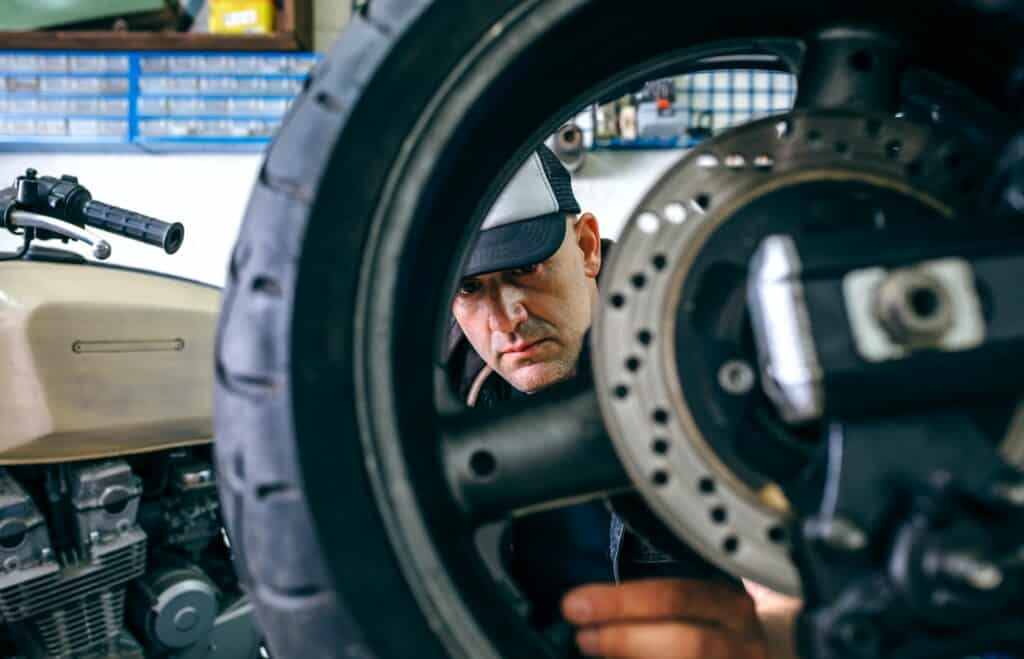
    Repairing motorcycle

    It’s not safe to hop on a motorcycle and not have the slightest idea of what you’re doing. You need to be an expert at handling the controls before going out on open roads. Knowing how your brake system works or how your engine works are safety-wise really important.

    You will also need safety instructions for knowing safety instructions about your safety gear like knowing where everything is located on your jacket, helmet, boots, etc… so that if something goes wrong with them you’ll be able to fix it right away without any trouble. If you don’t know how to handle safety-related stuff then I would recommend taking a motorcycle safety course.

    Stay off the phone

    Talking on your cell phone is an absolute no-no when riding a motorcycle. You never know what can happen with safety on the road, so anything that takes your safety attention away from the road should be avoided. Be smart, turn off your phone unless it’s an emergency, and always ride safe!

    Go through motorcycle safety courses

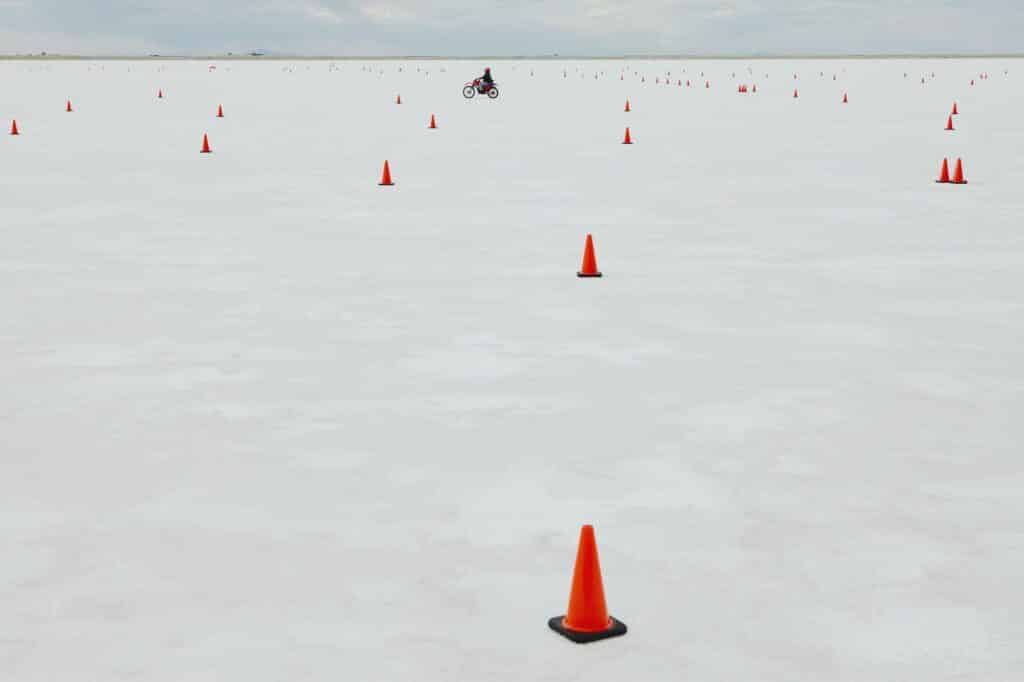
    Traffic cones on race course, Bonneville Salt Flats, during Speed Week.

    It might sound nerdy, but going through a motorcycle safety course can literally save your life! It’s safety-wise very important that you go through motorcycle safety courses so you have safety knowledge for riding safely on the road.

    Knowledge is safety, so if you know what to do if something were to happen while being out on the open roads then it’s a bonus. Though motorcycle safety courses are expensive, they are definitely worth it because your life depends on your safety skills and safety knowledge.

    Be aware of distracted drivers

    Driving being distracted is dangerous, especially if you’re not safety-minded. You can avoid safety issues by always staying focused on the road and what other vehicles are doing around you to make sure no safety hazards occur.

    It’s safety-wise very important to stay focused when riding a motorcycle. When you’re not paying attention, safety hazards can happen in an instant and it could be too late by the time you realize what is going on.

    Not talking on your phone while riding or even checking navigation will help you focus on the road and be aware of other distracted drives. Other drivers may even suddenly slam their brakes or make sudden turns without any signs because other vehicles aren’t thinking about you. Sadly, you can’t expect other vehicles to do what you expect them to do.

    A significant number of motorcycle riders involved in fatal crashes included a distracted driver hitting a motorcyclist.

    Look out for safety risks on the road

    Never ride your motorcycle in unsafe areas or areas that aren’t wide enough for two cars to drive safely side by side. Make sure that if two motorcycles drive next to each other, they can do so safely without causing any accidents with safety cars coming the other way.

    Always check for safety hazards like potholes, slippery roads/paths etc… before riding anywhere. If there’s a safety hazard present then try avoiding it as much as possible.

    Sadly, motorcyclists aren’t perfect, and we do make mistakes. Hitting or missing a pothole on a motorcycle can be the difference between fatal crashes or going home safely.

    Look for a bike with ABS safety

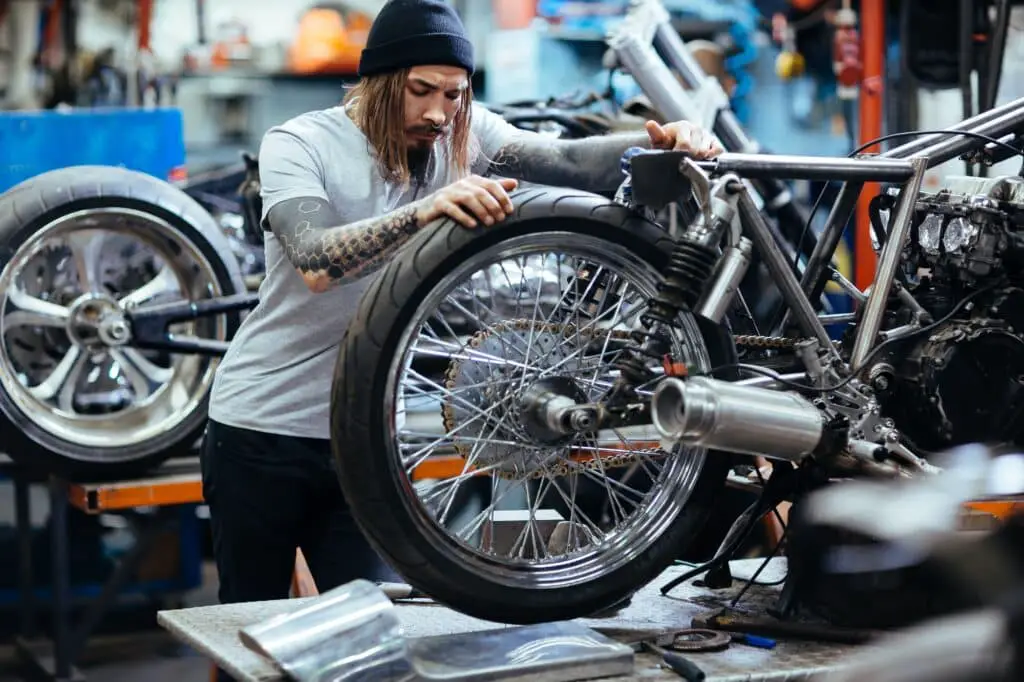
    Mechanic fixing custom motorcycle wheel

    ABS or anti-lock brakes systems are excellent for avoiding accidents and keeping you safe on the road. When braking quickly ABS kicks in to prevent your wheels from locking up, this helps you maintain control of your bike much better than non-ABS bikes do.

    If you’re planning on buying a new motorcycle it’s important to buy one with ABS included. If not, then look into getting ABS installed aftermarket since there are plenty of kits available that can help keep you safer by preventing your tires from locking up during emergency stops! Still, aftermarket ABS is expensive and it’s probably just worth buying a bike with ABS.

    If you don’t have ABS you will need to modulate the front wheel and rear wheel braking in real-time to simulate ABS.

    Be Extra Cautious In Car Parks

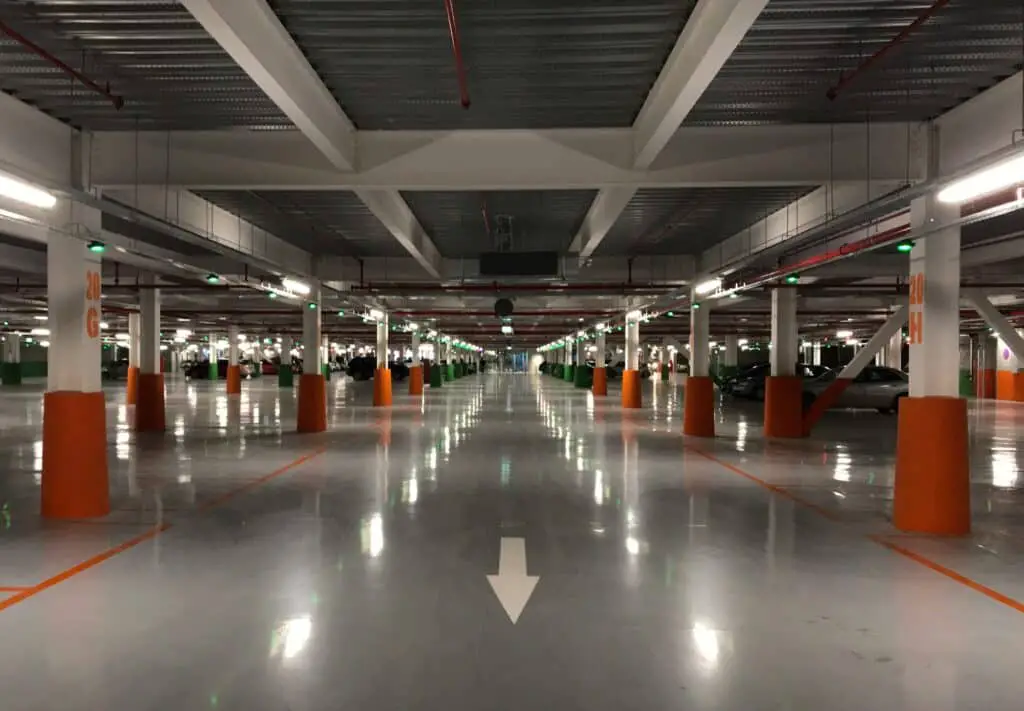
    Car park

    It might sound silly since you’re only going 5 mph, but car parks have some of the largest safety hazards. Look out for safe cars and also watch out for pedestrians that aren’t paying attention to their surroundings which can cause safety issues when riding through car parks.

    Car parks tend to have safety problems such as lack of safety signs, slippery ground, reduced speed limits, etc… Try staying away from crowded car parks because safety is an issue in crowded areas and it’s important to avoid safety issues when on a motorcycle.

    Avoid Riding In The Rain

    Riding in the rain can be very dangerous especially if you don’t own a safety motorcycle. Riding safety bikes means that they are built to handle safety hazards such as wet or slippery roads. If you’re not safety-minded then it’s important to avoid riding in the rain because safety issues can occur without your knowledge.

    If possible try avoiding riding on wet/slippery roads, though if you have to then make sure that safety is your number 1 priority while being out on the road! Even experienced bikers should think twice before riding in rainy weather…

    And if it’s snowing outside, don’t even think about riding!

    Conclusion

    If you’re safety-minded and careful, then there’s no reason why riding a motorcycle should be dangerous. In fact, it can even be enjoyable! We all try to avoid having a motorcycle crash, but ultimately it’s about being prepared for the unprepared.

    However, safety is still an issue for bikers which is why we’ve compiled this list of 10 safety tips to make sure your bike ride goes smoothly from start to finish. Follow these safety guidelines and always pay attention to the road so that your riding isn’t just fun but safe too!

  • Best Motorcycle Backpacks of 2022

    Best Motorcycle Backpacks of 2022

    Reading Time: 9 minutes

    A motorcycle backpack is a very important accessory for motorcyclists, whether they are going out on a long trip or a short one. Regular backpacks can often solve the problem of daily commuters but if you are looking to hop on your motorcycle and go for a long ride, you probably need a motorcycle backpack that is specifically designed for long trips.

    Moreover, if you love your bike and have invested in it and in other accessories, you should own a backpack that complements your motorcycle gear and your life as a rider.

    Here is a list of the best motorcycle backpacks of 2022, created after taking customer feedback, reviews, popularity, and other important points into consideration.

    OGIO No Drag Mach 5 Backpack

    This is one of the best ultra-aerodynamic backpacks in OGIO’s No Drag Backpack series. The backpack comes with a lot of pockets and there are expansion gussets present as well, which makes packing all your stuff in this backpack feel like a breeze.

    The streamlined shape of this backpack makes it resistant to buffeting at high speed and its aerodynamically molded exterior design gives you unmatched airflow that further reduces any drag during the ride. When it comes to features, this backpack is loaded with all the convenient ones – pocket for shoes, helmet-carrying strap, fleece-lined pocket for electronic gadgets, protective compartments for iPads and tablets, detachable hip belt with off-center attachments that prevent your bike’s gas tank from receiving unwanted scratches, a supremely designed deluxe organization panel that comes with pockets for valuables, and an adjustable load divider that helps you in even distribution of weights. The 20.5″H x 14.5″W x 7″D backpack has a capacity of 24L, which is expandable and with all these features, the backpack weighs only 3.7lbs.

    OGIO No Drag Mach 3 Backpack Stealth Black [Blemished – Very Good]

    This backpack has a slingshot molded exterior design and comes with a clamshell-type zipper that gives you the extra aerodynamic advantage on your rides.

    The backpack has advanced foam profiling that gives you unmatched air ventilation so that whenever you hit the road, there is no compromise in your comfort of riding. It has a separate pocket for shoes and the removable helmet strap allows you to free up your hands when you are not on the bike. The chest trap and the waist trap of the backpack are both detachable and it has 360-degree retro-reflective piping and logo that gives you all-around visibility and utmost safety. The interior lining of the backpack has an intense red color that helps you find even the smallest of things without wasting much time. The 19″ H x 12.5″ W x 6.5″ D backpack weighs only 207lbs and has a capacity of 18.4 L. The backpack is also hydration ready and it can fit most 15” laptops comfortably in its padded laptop sleeve that comes with an elastic closure.

    Buy Here

    Kriega R15 Backpack

    This backpack comes with a uniquely designed strap system that firmly puts the bag on your back but does not hinder your driving style or comfort when you are riding on your bike.

    The backpack has a capacity of 15L and comes with a 4-point pack compression feature.  It has organizer pockets, front sleeves, detachable waist strap, zipped inner mesh, integrated QUADLOC harness chest traps, and inner reservoir pockets that have 2-point pack compression. The innovative QUADLOC LITE harness gives you the convenience of a ‘one click and out’ feature and the angle of the harness is intentionally kept away from your armpits to give you that extra freedom of movement on your rides. The size of the top harness can also be adjusted accordingly to give you the optimum fit and the most suitable ‘backpack position’ on your back. The 16.9″ H x 9.8″ W x 5.9″ D backpack comes with an unmatched 10 Year Warranty that offers you peace of mind even when something goes wrong.

    Buy Now

    Kriega R20 Backpack

    This backpack from Kriega has an extremely well-designed buckle system that makes sure the backpack stays firm on your back when you are riding at a high speed, and at the same time, its aerodynamic characteristics do not make the backpack interfere in any way with your movements.

    The backpack is specifically designed for ‘active’ riding and therefore, the intelligent design of the buckle and the QUADLOC LITE harness system. Instead of angling under your armpits, the angle of the harness stays away from the conventional position to give you the most freedom in your movements. Once the harness is set, there is no need for unnecessary adjustments on conventional lock systems, which makes it an exceptionally convenient feature of the backpack. The backpack has a capacity of 20L and comes in the dimensions of 18.5″ H x 11″ W x 5.9″ D. It has a warranty period of 10 years which definitely makes this backpack a popular choice among the ‘active’ riders.

    Buy Now

    Kriega R25 Backpack

    This backpack from Kriega is mid-sized and has dual chest traps to it, for a firm but convenient support during riding. The backpack is ergonomically designed using advanced technology to free you up from any bothering arm restrictions during the long rides.

    The QUADLOC LITE harness system is an innovation from Kriega in the rucksack industry that is tried and tested for its quick-release feature. The harness is uniquely designed for efficient load-bearing and unlike the conventional systems, the weight of the load does not fall on your shoulders but on your hip and chest. This helps to keep your neck muscles free of any strains in the long run. The side-access pockets of the backpacks have a 4-point pack compression system and the fabric which is used is 5mm SUPERSPACE (airspace) fabric.  The outer pockets of this 25L capacity backpack are expandable and the internal magazine sleeve can accommodate most laptops of 14”. The backpack is fully hydration compatible with the hydration tubes coming out and over the shoulder of the backpack, through a hidden duct, located at the top center of the primary compartment. The backpack comes in a dimension of 20.5″ H x 11.8″ W x 6.3″ D and has a 10-Year warranty period.

    Buy Now

    Kriega R30 Backpack

    This backpack comes with a uniquely designed chest buckle harness and a waterproof main compartment. With this backpack on your ride, you can brave the harsh rains and keep all your belongings safe and sound, no matter where you go or how long you ride.

    The backpack is 100% water resistant and has a 6-point pack compression feature with 2 outer zipped pockets which are water resistant as well. The QUADLOC LITE harness relieves your shoulders, armpits, and neck muscles from excessive strain and allows you total freedom of movement for your long-distance rides. The backpack has a capacity of 30L, which makes it accommodating for all kinds of stuff, and can even fit all laptops in its laptop compartment that are 17” or less. It has a dimension of 19.3″ H x 11.8″ W x 8.3″ D and comes with an integrated 3M Scotchlite reflectivity. Made specifically for bikers, the backpack also has a 10 -warranty period.

    Buy Now

    KTM PowerWear Team Baja Hydration Pack

    This backpack is made for racing or speedy rides. The aerodynamic design helps in reducing drag at high speed and the weight of the backpack makes it a favorite among riders.

    All the compartments of the backpack are spacious enough for storing all your belongings, from your cargo and accessories to your tools and food. The backpack has a capacity of approximately 8L and the dimensions are 16″ H x 10″ W x 5″ D. The 100% nylon material gives it the durability that all riders need for their bike gear. The backpack weighs only 1.8lbs but when it comes to storage, you will be surprised to see its actual capacity. The backpack fits perfectly on your back, whether you are wearing the armor or not.

    Buy Now

    Klim Nac Pak With Shape Shift 3 Liter Hydrapak

    This backpack is specifically designed for riders who love going long distances. The ergonomic design of the backpack reduces any drag that you can encounter at high speed and allows you to go that extra mile without compromising on the comfort front.

    The backpack is loaded with features that are most important to any rider – big cargo-carrying capacity, accessories carrying convenience, and quick access to tools storage. In addition to the tool storage pack of the backpack which is water-resistant and detachable, it has external storage for shovels and is large enough for small and medium-sized laptops. The shoulder straps of this backpack are inspired by racing and therefore, they are designed intelligently to integrate into your sternum as side straps, without putting excessive pressure on your hips. The 3L Hydrapak of this backpack comes with shift bladders that can be accessed quite easily while riding.  

    Buy Now

    Givi EA104B / EA104GR Easy-T Backpack

    A T-shaped backpack that can completely fit your helmet and can still have a comfortable place for your laptop and other belongings.

    The most unique feature of this backpack is that you can free up your hands completely by keeping your helmet in the backpack’s convertible compartment. The capacity of the backpack is 17L but the convertible feature makes it expandable up to 24L. The backpack comes with reflective piping and a fine raincoat cover that keeps your belongings and valuables safe from the harsh rains. The helmet-carrying pouch is what makes this backpack a popular choice among riders. The laptop compartment of the backpack fits most laptops that are 13” or less. The dimensions of the bag are 16.9″ H x 16.5″ W x 5.5″ D and in its fully expanded state, the diameter expands to 9.5″ from 5.5”.

    Buy Now

    Icon Crosswalk Backpack

    The aerodynamic design of this backpack makes it a favorite among regular riders. It comes with reflective webbing and a separate helmet carrier system that has a tether clip attached to it for locking up the helmet.

    The size of this backpack is absolutely perfect. It’s neither too big for your comfort nor too small for your belongings. The capacity of the backpack is 18L, which makes it the right choice for daily commuters or for a short trip. The backpack comes with padded straps that are specially designed and contoured to give you the utmost comfort on your two-wheeler. Another great thing about the straps is that you can unbuckle them as per your wish. The straps can even be unbuckled to suit your convenience. For instance, you can easily strap it on when wearing heavy armor for the ride. The aerodynamic design is also great and reduces any drag when you are at high speed. The dimensions of this backpack are 20″L x 13″W x 7″D, which is an add-on to its convenience and comfort.

    Buy Now

    The Bottom Line

    Choosing the best motorcycle backpack for 2022 is not very simple as you have to keep in mind everything from the smallest details of your requirements to your specific riding style. This list will save you the trouble of spending extensive time looking for the perfect backpack that suits your style and expectations.

    All the backpacks listed here are specifically suited for bike rides and contain all the features that a biker expects a comfortable backpack to have. So, what are you waiting for? Browse through the list and choose the backpack that’s the perfect fit for you to make your next ride more thrilling and enjoyable.

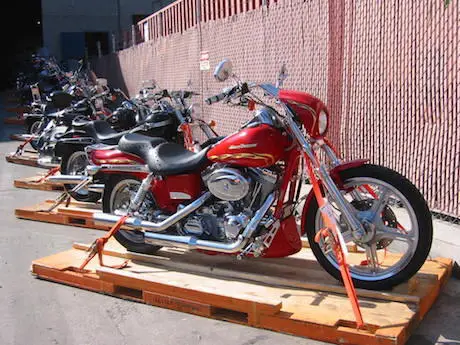
  • Transporting a Motorcycle Without Riding: 5 Different Ways

    Transporting a Motorcycle Without Riding: 5 Different Ways

    Reading Time: 5 minutes

    There are heaps of reasons a biker might be needing to transport a motorcycle without riding it. Maybe you’ve just bought a bike online from someone in another state, maybe the bike itself can’t run or you’re moving cross country and don’t want to ride your bike down with you, you’d rather fly.

    If you don’t know what you’re looking for when transporting a motorcycle, it can be a very difficult task if you don’t know the process. Luckily, we have 5 ways of transporting a motorcycle that doesn’t require you to ride it!

    5 ways to transport a motorcycle

    1. Hire a Trailer/Pick-Up
    2. Put Bike in a Moving Truck
    3. Freight Company
    4. Independent Hauler
    5. Professional Motorcycle Shipper

    Hire a Trailer Or Pickup Truck

    Hiring a trailer or pickup truck is the best option for transporting your bike in the same city. For example, you’re moving across town or across town for a couple of days.

    If you have a friend or family who is willing to help you out by giving you a hand with the moving process of your motorcycle, all you need is a pickup truck and trailer.

    You want to make sure the bike doesn’t get damaged, but you don’t necessarily want to drive it all around or leave it in some parking lot while you are away.

    The pickup truck option is the best choice if you have some friends who can help you load and unload. Don’t forget insurance – Hiring a trailer is generally cheaper than hiring a pick-up truck and they come with insurance and roadside assistance included, so make sure that’s part of the deal too!

    You can use a flatbed trailer that has been made for motorcycles, which will allow your bike to be strapped down securely while being towed.

    A pick-up bed can also work just as well if it’s long enough, just ensures the tailgate locks so that it doesn’t come open mid-drive. A pickup is definitely higher & harder to get the bike onto than a trailer, but if you’re on a budget and just need to get it moved across town, you can’t go wrong.

    When using a pickup or trailer it’s really up to you to make sure that you’ve strapped down your bike well enough. You don’t want your bike to start flying around while you’re driving or when you stop, so make sure it’s strapped down with proper trucky straps.

    Put Bike in a Moving Truck

    If you’re moving house and have hired professional movers consider asking them to put your bike in the back of the truck with the rest of your stuff. A lot of movers will be fine to do this as standard.

    But some movers will charge extra for this service, but if you’re able to get it free – it’s the most convenient option out there. There are no fees for renting a trailer, finding parking, insurance, etc… And let’s face it – how many people do you know with a moving truck? Not many!

    You’ll also need to ensure that your bike is safe and secure while being transported inside the moving truck. It’s a good idea to ask the moving company if the bike is also insured in the move.

    Another good idea would be strapping the bike down into a wooden crate to keep it safe, so the truck doesn’t get too crazy while driving.

    Freight Company

    If you’re moving a bike cross country or buying/selling a bike from another city then a freight company might be the way to go. Sometimes a shipper will be the best option if you’re moving somewhere long distance and need an option other than flying with it.

    Most freight companies can pack up your bike for you, and have it shipped directly to their new home so that when they get there all they’ll have to do is take the box off the truck, take it inside, and ensure it arrives perfectly in one piece.

    The only downside about using a freight company is how much it’s to cost you!

    Most major freight companies will charge you based on distance and weight, but it’s also important to realize that motorcycles are high-value items so their fees will be higher than a standard freight truck.

    Freight companies can pack the bike for you and ship it to your new home, but they might ask if you want to do it yourself to save some money.

    Independent Hauler

    Another good option for transporting a bike is an independent hauler. An independent hauler is someone who will haul just about anything from one place to another for you.

    They typically charge based on weight but if it’s a short distance they may take the full load and do it for a flat fee, which can actually work out cheaper than using a trucking company.

    Usually, independent haulers have their own trailers or trucks so you don’t have to worry about renting or buying your own – they’ll bring their own!

    Basically, an independent hauler is a good option if you need a cheap way to transport something long-distance without leaving it in a parking lot somewhere.

    Professional Motorcycle Shipper

    If you are after the most hands-off, best service, simplest and best solution, then a professional motorcycle shipper might be right for you.

    Professional motorcycle shippers such as Motorcycleshippers are experts at what they do and you can rest assured that your bike will be handled with care & quickly transported to its destination without any hassles.

    As a professional motorcycle shipper, Motorcycleshippers will pick up the bike from where it is; whether it’s in another city or state, or if it’s still on the showroom floor! They will then transport the bike securely & safely to their chosen location and deliver it directly to your door.

    A professional motorcycle shipper like this will not only save you time and money but you’ll also have one less thing to worry about when transporting a motorcycle.

    If your bike is your prized possession, go with the pros. You won’t regret it.

  • Motorcycle Chain Tension: Too Tight Or Loose

    Motorcycle Chain Tension: Too Tight Or Loose

    Reading Time: 4 minutes

    For most motorcyclists a motorcycle chain is just there, we know what it does, but we don’t really need to consider its tension. However, if we want our motorcycle to run in the best possible way, knowing a little more about your motorcycle chain’s tension can help!

    Why is your motorcycle chain tension important?

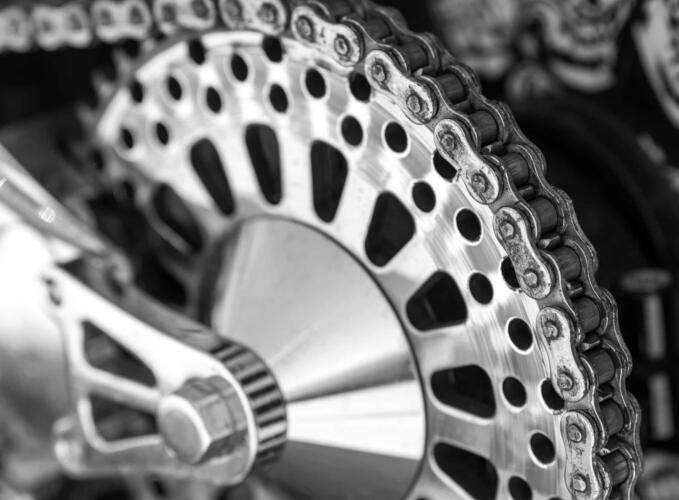
    The tension of a motorcycle chain is an important factor in the smooth running of your bike and its longevity. The purpose of a motorcycle chain is to drive the rear wheel. It is a system of gears that transmits rotation and power from the engine through the transmission and to the rear wheel with as little loss as possible.

    With your motorcycle chain, you can change gear ratios and multiply torque so you can go fast or slow depending on the circumstances. However, if your chain is too loose it will slip and wear out quickly, but too tight may lead to serious damage such as melted chains!

    What will happen if your motorcycle chain is too tight?

    If your motorcycle chain is too tight it will put more strain on the drive train components which will lead to increased wear and tear. If your bike has an aluminum chassis this can be particularly bad news as the added force may cause bending or snapping! If your bike doesn’t have an aluminum chassis then your chain might just keep slipping off, or if left for a long period of time it could stretch making all future adjustments useless.

    What happens if my motorcycle chain is too loose?

    A loose chain will do exactly what you expect it to do! To go back to our car analogy, think about driving without putting your seat belt on – you could get in serious accidents if anything were to happen! Not only does a sliding chain mean that your motorcycle will not be running in the most efficient manner, but it also means that your sprockets can end up getting damaged or worn down.

    How long does a motorcycle chain tension last?

    The average new motorcycle chain tension will last 3000 miles but for an older chain, you would want to check tension every 750 miles.

    If you’re not sure how to check your motorcycle chain tension, a good option is to take your bike to a local mechanic’s workshop or dealer. They will be able to inspect the quality of your chain and fix any problems that might arise within 5 minutes! This way you can feel safe knowing that you are riding on a fully functional machine!

    How do I keep my motorbike chain tension optimal?

    Keeping a check on a motorcycle’s chain tension means checking it before every ride. The best way to do this is to push down on the rear suspension as hard as possible just before you jump on your bike. If you have been adjusting your motorcycle’s chain tension yourself then you should be looking at about 1/4″ – 3/8″ of movement if you put the bike in 6th gear (the gear closest to your ground) and pull hard on the suspension.

    Now, I’m not suggesting you need to tighten or loosen every time you want to go for a ride, but if you often find yourself adjusting your chain’s tension then it’s either too tight or too loose.

    If you’re finding that it is constantly either too tight or too loose then there is most likely something wrong with your chain adjustment system. If this happens, take your bike to your local motorcycle mechanic! They’ll sort out any problems that you might have with your chain tensioner within 5 minutes and without breaking the bank!

    Can I adjust my own motorcycle chain tension?

    You can definitely adjust your own motorcycle chain tension. Adjusting your own motorcycle chain tension is not as easy as putting up an Ikea bookshelf but it certainly isn’t hard either.

    Watch the following video for a full tutorial

    Conclusion

    Keeping your bike chain tension in check is essential for keeping your motorcycle in top condition! Remember that too tight is bad and too loose may cause damage, so by checking it before every ride you are being proactive about the longevity of your motorcycle.

  • Learning To Ride Motorcycle: 5 Ways To Teach Yourself

    Learning To Ride Motorcycle: 5 Ways To Teach Yourself

    Reading Time: 5 minutes

    Many motorcycle riders have successfully taught themselves how to ride a motorcycle. In the past, the majority of people had to learn on their own how to ride a motorcycle because of a lack of alternatives.

    It’s just that riding a motorcycle although, is similar to riding a bicycle, but a bit more dangerous. So, you have to be careful and like all driving lessons, you need to keep your senses sharp and be completely aware of your external surroundings.

    The best way to teach yourself to ride a motorcycle is to hop on an actual motorcycle with an experienced rider present.

    However, if you are determined to learn to ride all by yourself, you can teach yourself the basic skills of how to operate a motorcycle with books and videos as resources.

    5 Ways to Teach Yourself How to Ride a Motorcycle

    • Get Yourself Proper Motorcycle Gear
    • Go to an Off-Road Park
    • Practice on Dirt Pits or Trails
    • Read Books and Watch Training Videos
    • Get a Cheap Motorcycle to Practice On
    • Be Patient

    Get Yourself Proper Motorcycle Gear

    Riding a motorcycle is not exactly like riding a bicycle. You should teach yourself how to ride a motorcycle with the proper gear, including thick boots, gloves, long pants, and padding in all of your joints and ribs.

    Make sure you can’t feel anything uncomfortable when you walk around wearing all of your motorcycle gear. If something pinches or feels highly uncomfortable, the gear probably is too small or ill-fitting for serious riding.

    It does not matter whether your gear matches your motorcycle or you look good in it. What matters is that every part of the gear protects you from an injury in the event of an unfortunate accident.

    Go to an Off-Road Park

    An off-road park is a great place to teach yourself how to ride a motorcycle.

    Off-road parks teach you how to move beyond simple riding in a straight line and also teach you how to go over bumps, curves, hills, and jumps without going too fast or losing control of the bike. An experienced rider can give you pointers on how they do it by watching your progress from a distance.

    Do not teach yourself how to ride on a busy street, especially if you are learning by yourself. This is because it will be difficult to learn the right skills without the help of an experienced rider.

    Practice on Dirt Pits or Trails

    You can teach yourself how to ride a motorcycle without the help of another person by practicing your skills on dirt trails or pits. You may need someone to teach you how to shift gears properly before you teach yourself how to do so, but after that, it is all up to you.

    Practice riding at slow speeds while leaning over the handles and not using your breaks. Once you get used to maneuvering your motorcycle in this way, practice accelerating while still leaning over the handlebars until it feels comfortable for you. Then learn how to put the brakes on, without crashing into anything else around you.

    Read Books and Watch Training Videos

    Many people teach themselves how to ride a motorcycle by reading books and watching training videos.

    There are many different ways you can teach yourself how to ride a motorcycle with the help of books, including buying a book on bike riding, setting up your classroom environment, or even getting an online guide.

    Even if it seems that all of this information is useless to you at first glance, teach yourself what is useful and ignore the rest. There are a lot of videos on Youtube to help you out with but whenever you are learning from books and videos, you must take everything slowly, and use your common sense. Do not rush ahead too quickly!

    Get a Cheap Motorcycle to Practice On

    If you do not have the money right now to buy a good-looking and expensive motorcycle, it’s a boon for you, especially if you are looking to teach yourself how to ride a motorcycle.

    A cheap, inexpensive motorcycle can teach you useful skills. The motorcyclist skill development process is the same as any other type of vehicle learning. You have to teach yourself how to take it easy at first, and progress to speedier driving as you get more familiar with the feel of the motorcycle.

    With a cheap motorcycle, your first experiments will never be too risky since all you are risking is less money for this learning experience. There are many people out there who teach themselves how to ride using this method and they teach themselves successfully because it is easier for them to make mistakes on a used or a smaller bike.

    Be Patient

    One great thing about teaching yourself how to ride a motorcycle is that it teaches you how to be patient by fine-tuning your senses.

    Teaching yourself how to ride can be difficult, even if you think you are ready. If at any point something feels hard or confusing, give yourself some time off before starting again.

    Even if it means taking a day off from learning your self-riding skills. Come back tomorrow with a fresh mind and more patience on your side. You will be much more prepared in your mind, in that way.

    Conclusion

    Learning motorcycle skills can be done in many different ways, such as watching instructional videos or learning from another person.

    Read books about riding motorcycles, watch training videos, and on top of everything, practice as much as possible.

    Practice at slow speeds on dirt pits and trails, and take your time mastering each skill instead of rushing forward. For your practicing and learning days, always settle for an inexpensive motorcycle so that even if an accident happens, it does not burn a hole in your pocket, besides giving you physical injuries.

    Always use good quality protective gear and be very careful when you teach yourself how to ride a motorcycle. You do not want your first experience on two wheels to end in a bad way!

  • Motorcycle Deaths: How Many Motorcyclists Die Each Year? Worldwide

    Motorcycle Deaths: How Many Motorcyclists Die Each Year? Worldwide

    Reading Time: 6 minutes

    In the year ending April 30, 2021, 229 motorcycle-related deaths were reported in Australia. As reported by the National Highway Traffic Safety Administration, 5014 people died in motorcycle accidents in the USA. According to WHO, India has the highest death rate due to bike crashes.

    When it comes to motorcycle injuries, most developing nations keep it underreported. Globally, motorcycle accidents are responsible for a significant proportion of overall road traffic injuries and fatalities. Amongst all accidents, most occur in developing nations. Sadly, deaths from motorcycle crashes are dramatically increasing EVERY YEAR! 

    When compared with cars, motorcycles are much less stable due to their high-performance capabilities. As its rider lacks the protection of an enclosed vehicle, when it crashes, they are more likely to get injured. According to a report, motorbikes account for around 0.6% of all vehicle national miles driven but account for more than 14% of road fatalities in the US. Though there are many reasons for this high rate of fatalities with motorcycle crashes, the most common one is that the other colliding vehicle didn’t see the bike until it was too late. 

    Are Motorcycle Deaths Rising Or Falling?

    In Australia, 210 motorcycle crash deaths were reported in 2019. Though the overall death rate was higher than 2018,  2016 was the peak as in that year the death rate from motorcycle accidents reached 249. Amongst all accidents on Australian roads, motorcyclists account for 27% of serious injuries. 50% of such injuries are due to multi-vehicle crashes and thus, are more fatal than single-vehicle crashes. According to the World Health Organization (WHO), head injuries are the primary cause of deaths in motorcycle crashes. 

    Presently, the rate of death due to motorcycle accidents is around 4.5 per 100,000 individuals. According to the data, people of the age group between 40–64 have the highest fatalities. In Australia, both 2014 and 2018 had the lowest death cases (192 fatalities) due to motorcycle crashes. 

    Just like Australia, in other parts of the world like in America, around 5014 motorcyclists died in motorcycle accidents in 2019. Though after 1980, deaths due to bike crashes significantly declined, it again started increasing from 1998 and continued through 2008. According to a report, in 2019, fatality due to motorcycle crashes accounts for 14% of all road accident deaths, which is more than double the number of motorcyclists’ deaths in 1997. 

    In developing nations like India, Malaysia, Myanmar, Thailand, Indonesia, and many more, the number of motorcycle-related death cases is staggering. The number is running into the millions in total. For example, in the year 2001, the number of motorcycles in Vietnam increased by 29%. This growth percentage increased the number of road traffic deaths by 37%. 

    What Causes Most Motorcycle Deaths?

    Though there is a number of reasons that can cause motorcycle crashes, some of the common ones are as follows: 

    • One of the important causes of motorcycle crashes is unsafe lane changes. In most cases, a driver collides their vehicle with a motorcycle when they fail to understand their blind spot. Many times, they also miss out on signals while changing lanes that result in collisions. 
    • Speeding is one of the leading causes of road traffic accidents, especially motorcycle crashes. As a motorcycle is a more high-performance vehicle than a car, speeding might reduce the driver’s control over it. Speeding also reduces the chances of seeing and reacting to obstacles and other vehicles in time. Thus, it is always advised to maintain a controlled speed while riding a bike. Remember, the higher the speed of the motorcycle, the more severe the impact and the consequences. 
    • Driving under the influence of drugs or alcohol can be fatal. Also, driving under the influence of drugs or alcohol is a criminal and social offence. Thus, always drop the idea of drinking while driving, as it can be life-threatening.
    • Riding a motorcycle is fun. However, if you are breaking the rules of driving to make the ride more adventurous, it can be fatal. One of such adventurous practises that many motorcyclists practise is lane splitting. Lane splitting is about driving between two lanes. The practice is not only illegal in most countries but also increases the chances of head-on collisions. 
    • The helmet is one of the most important gears that every motorcyclist must wear while riding. According to the National Highway Traffic Safety Administration, for every 100 motorcyclists killed in crashes, 37 die because of not wearing helmets. A good helmet decreases the chances of head injury due to crashes. 
    • Collisions between vehicles taking left turns and motorbikes are very common. Driver’s distraction, low visibility, speeding, etc. are the causes of left-turn accidents. To avoid such situations, it’s important for both the motorcyclist and the car driver to obey the traffic rules. 
    • Lack of motorcycle maintenance is another factor that might cause road accidents. Thus, before hitting the roads, it is important for riders to check if their bikes are in good condition. Check engine performance, tyre pressures, and other technicalities before starting off your journey. Consider taking your motorcycle to professionals for regular services. 
    • Potholes, crumbling roads, lack of necessary signs and signals can make a motorcycle ride dangerous. It can increase a rider’s chance of losing control of their vehicles and might cause serious accidents and even deaths. 

    Which Countries Have The Highest Number Of Deaths?

    Compared to other road accidents, motorcycle crashes account for the highest death rate around the world. Every year, it runs into the millions in total. Though it is a global concern, there are a few countries in which deaths due to motorcycle crashes are higher than the rest. Here’s the list:

    • India is the country with the highest number of deaths due to bike crashes. According to WHO, 33% of total traffic-related deaths are attributed to bikes. Though the percentage is low, in terms of mere numbers, it is 98,700 every year
    • Thailand has dangerous roads and here,  motorcyclists are known for their harsh riding. The country accounts for a 74.4% death rate amongst all road traffic death cases. 
    • Indonesia has the largest motorcycle market in the world. More than half of the population here owns a vehicle, especially motorcycles. However, only 71% of motorcyclists in Indonesia wear helmets. The country accounts for 73.6% of death cases due to motorcycle accidents. 

    Countries, where motorcycles make a large proportion of traffic, have the highest motorcycle-related death cases. For example, in the UK, motorcycles or scooters constitute a small section of road traffic and thus, it has only 20.5% of death cases due to motorcycle crashes. Here’s the list of the top 10 countries with the highest proportion of death cases due to motorcycle accidents. 

    1. Thailand- 74.4%
    2. Indonesia- 73.6%
    3. Cambodia- 73.5%
    4. Republic of Togo – 71.6%
    5. Dominican Republic – 67%
    6. Myanmar – 64.8%
    7. Malaysia – 60%
    8. The Republic of Benin 56.5%
    9. Colombia – 52.5%
    10. Paraguay – 52.2%

    Unlike car accidents, motorcycle accidents are much more dangerous and fatal. If we just consider the United States, bikes and scooters account for 3% of all the registered vehicles, yet they have a high number of traffic fatalities and injuries. Motorcyclists have the risk of fatal crashes that is almost 35 times greater than any other vehicle. 

    However, the fatality rate across the globe can be reduced with better motorist awareness. Safe riding practices, along with cooperation from road maintenance authorities, pedestrians and other vehicle drivers, can bring down the fatalities and injuries significantly. Vehicle drivers should also be aware of the safety challenges of motorcyclists to avoid crashes. At the end of the day, a sound awareness on the part of motorists, both riders and drivers, can make the experience much safer.